


Page 414 - (DK) Ocean - The Definitive Visual Guide
P. 414
412     ANIMAL LIFE


                  ORDER CETACEA              180 decibels, is louder than the sound
                                             of a jet aircraft taking off. This animal’s   BALEEN
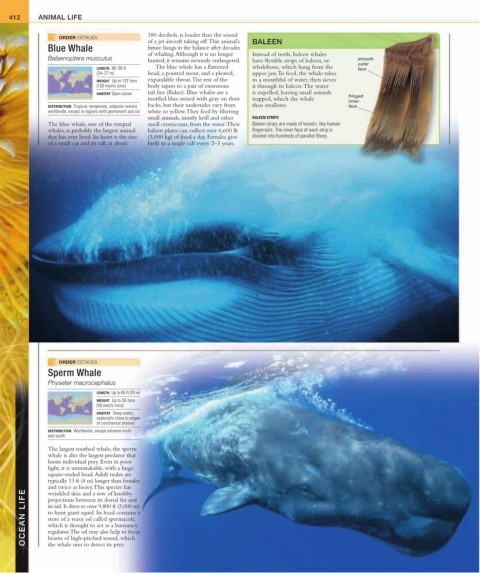
               Blue Whale                    future hangs in the balance after decades
                                             of whaling. Although it is no longer   Instead of teeth, baleen whales
               Balaenoptera musculus         hunted, it remains seriously endangered.   have flexible strips of baleen, or   smooth
                                                                                                            outer
                              LENGTH  80–90 ft   The blue whale has a flattened   whalebone, which hang from the   face
                              (24–27 m)      head, a pointed snout, and a pleated,   upper jaw. To feed, the whale takes
                              WEIGHT  Up to 132 tons   expandable throat. The rest of the   in a mouthful of water, then sieves
                              (120 metric tons)  body tapers to a pair of enormous    it through its baleen. The water
                              HABITAT Open ocean   tail fins (flukes). Blue whales are a   is expelled, leaving small animals   fringed
                                             mottled blue mixed with gray on their   trapped, which the whale    inner
               DISTRIBUTION  Tropical, temperate, subpolar waters   backs, but their undersides vary from   then swallows.  face
               worldwide, except in regions with permanent sea ice  white to yellow. They feed by filtering
                                             small animals, mostly krill and other   BALEEN STRIPS
               The blue whale, one of the rorqual   small crustaceans, from the water. Their   Baleen strips are made of keratin, like human
               whales, is probably the largest animal   baleen plates can collect over 6,600 lb   fingernails. The inner face of each strip is
               that has ever lived. Its heart is the size   (3,000 kg) of food a day. Females give   divided into hundreds of parallel fibres.
               of a small car and its call, at about    birth to a single calf every 2–3 years.


                  ORDER CETACEA
               Sperm Whale

               Physeter macrocephalus
                              LENGTH  Up to 65 ft (20 m)
                              WEIGHT  Up to 55 tons
                              (50 metric tons)
                              HABITAT  Deep water,
                              especially close to edges
                              of continental shelves
               DISTRIBUTION  Worldwide, except extreme north
               and south
               The largest toothed whale, the sperm
               whale is also the largest predator that
               hunts individual prey. Even in poor
               light, it is unmistakable, with a huge,
               square-ended head. Adult males are
               typically 13 ft (4 m) longer than females
               and twice as heavy. This species has
        OCEAN LIFE  its tail. It dives to over 9,800 ft (3,000 m)
               wrinkled skin and a row of knobby
               projections between its dorsal fin and
               to hunt giant squid. Its head contains a
               store of a waxy oil called spermaceti,
               which is thought to act as a buoyancy
               regulator. The oil may also help to focus
               beams of high-pitched sound, which
               the whale uses to detect its prey.

