


Page 489 - (DK) Ocean - The Definitive Visual Guide
P. 489
487
Ice-shelf Breakup
Ice shelves are extensions of Antarctica’s ice sheets
ICE SHELVES IN RETREAT
over the sea. Continually pushed away from the land
by the weight of accumulating snow, an ice shelf
gradually advances over the ocean until its front
breaks off to form a tabular iceberg. This advance and
retreat is part of a natural cycle, but in the Antarctic
Peninsula, some small ice shelves have suffered
catastrophic collapses as a result of regional warming
of 5˚F (2.8˚C) over the last 50 years. In 2008, for
example, the Wilkins Ice Shelf lost around 200 square
miles (500 square km).
Although the loss of floating ice does not
affect global sea levels, it seems that the adjacent
continental ice sheet may become unstable if it loses
the “buffer zone” provided by an ice shelf. After the MELTWATER POOL In the
summer, meltwater collects in
Larsen B Ice Shelf collapsed in 2002, scientists
low-lying parts of the surface of
measured nearby glaciers flowing between two and an ice shelf, including crevasses
eight times faster than they had before. It is not yet and depressions. Melting also
occurs on the underside.
clear whether the larger Ronne and Ross ice shelves
act as a similar brake on the West Antarctic Ice Sheet. CRACK IN LARSEN A The
If the regional warming continues and the West additional weight of meltwater
Antarctic Ice Sheet collapses as a result, global sea CRACKING UP may increase the pressure at
the base of a crevasse, causing
levels could rise more than 16 ft (5 m), threatening it to penetrate deeper into the
densely populated coastal areas worldwide. ice shelf and to widen.
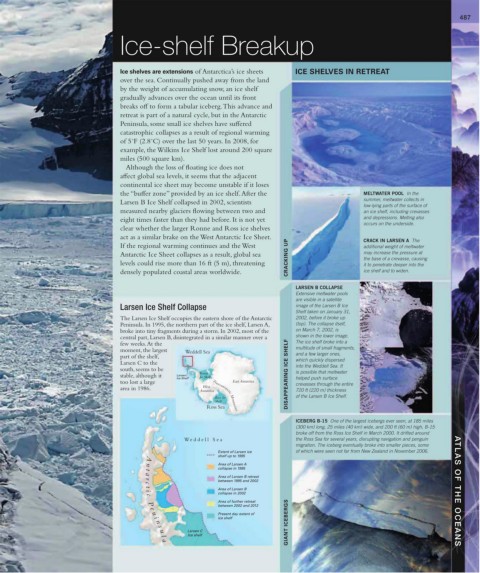
LARSEN B COLLAPSE
Extensive meltwater pools
are visible in a satellite
Larsen Ice Shelf Collapse image of the Larsen B Ice
Shelf taken on January 31,
The Larsen Ice Shelf occupies the eastern shore of the Antarctic 2002, before it broke up
Peninsula. In 1995, the northern part of the ice shelf, Larsen A, (top). The collapse itself,
broke into tiny fragments during a storm. In 2002, most of the on March 7, 2002, is
central part, Larsen B, disintegrated in a similar manner over a shown in the lower image.
few weeks. At the The ice shelf broke into a
moment, the largest Weddell Sea multitude of small fragments,
and a few larger ones,
part of the shelf, which quickly dispersed
Larsen C to the into the Weddell Sea. It
south, seems to be is possible that meltwater
stable, although it Larsen Ronne DISAPPEARING ICE SHELF
Ice Shelf
Ice Shelf helped push surface
too lost a large East Antarctica crevasses through the entire
area in 1986. West 720 ft (220 m) thickness
Antarctica
Ross Ice of the Larsen B Ice Shelf.
Shelf
Ross Sea
Transantarctic Mountains
ICEBERG B-15 One of the largest icebergs ever seen, at 185 miles
(300 km) long, 25 miles (40 km) wide, and 200 ft (60 m) high, B-15
broke off from the Ross Ice Shelf in March 2000. It drifted around
Weddell Sea the Ross Sea for several years, disrupting navigation and penguin
migration. The iceberg eventually broke into smaller pieces, some
Extent of Larsen ice of which were seen not far from New Zealand in November 2006.
shelf up to 1995
A
Area of Larsen A
n
collapse in 1995
t
Area of Larsen B retreat
a
between 1995 and 2002
r
c
Area of Larsen B ATLAS OF THE OCEANS
t
i
collapse in 2002
c
GIANT ICEBERGS
Area of further retreat
between 2002 and 2012
P
e
Present day extent of
n
ice shelf
i
n
s
Larsen C
u
Ice shelf
l
a

