


Page 96 - (DK) Ocean - The Definitive Visual Guide
P. 96
94      COASTS AND THE SEASHORE


                  ATLANTIC OCEAN NORTHWEST
               Greenland Ice Coast

                              TYPE  Primary coast
                              FORMATION  Extension of
                              ice-sheet to sea level in
                              outlet glaciers
                              EXTENT  About 600 miles
                              (1,000 km)
               LOCATION  Parts of western and eastern coasts of
               Greenland
               An ice coast forms where a glacier
               extends to the sea, so that a wall of ice
               is in direct contact with the water.
               This is a common feature around the
               highly indented margins of Greenland,
               mainly at the landward end of long
               fjords. Together, these ice walls form
               an interrupted ice coast, and they are
               the source of enormous numbers of
               icebergs, many of which escape the
               fjords and eventually reach the
               Atlantic. The ice coast extends along
               only a fraction of the total Greenland
               coastline, which is an astonishing
               27,500 miles (44,000 km) long.


                                                                           is found within a single large island,   MOUNT DESERT ISLAND
                                                ATLANTIC OCEAN NORTHWEST
                                                                           Mount Desert Island, and some smaller   The south-facing coast of Mount Desert Island
                                             Acadia Coastline              associated islands. Sea-level rise since   consists of a series of fractured granitic steps
                                                                           the last ice age has separated these   that were produced by the action of glaciers
                                                           TYPE  Primary coast  islands from each other and from the   some 100,000 years ago.
                                                           FORMATION  Glaciation,   mainland. The mountains that make
                                                           then drowning by   up the basis of this coastline began    separated by U-shaped valleys. Since
                                                           sea-level rise   to form 500 million years ago from   the ice sheet receded, the land has
                                                           EXTENT  41 miles (66 km)   seafloor sediments. Magma (molten   gradually rebounded upward, but
                                                                           rock) rising up from Earth’s interior   global sea-level rise has caused the
                                             LOCATION  Southeast of Bangor, Maine,    intruded into and consumed these   Atlantic to overtake the rebound at a
                                             northeastern US               sedimentary rocks, producing a mass   rate of 2 in (5 cm) per century. Today,
                                                                           of granite that was gradually eroded to   waves and tidal currents are major
                                             The coastline of Acadia in Maine is   form a ridge. About 2–3 million years   agents of change at Acadia, gradually
                                             one of the most spectacular in the   ago, a huge ice sheet started to blanket   eroding the cliffs and depositing rock
                                             northeastern US. It now forms the   the area, depressing the land and   particles mixed with shell fragments at
               ICE COAST NEAR CAPE YORK      Acadia National Park, most of which    sculpting out a series of mountains   coves around the coastline.


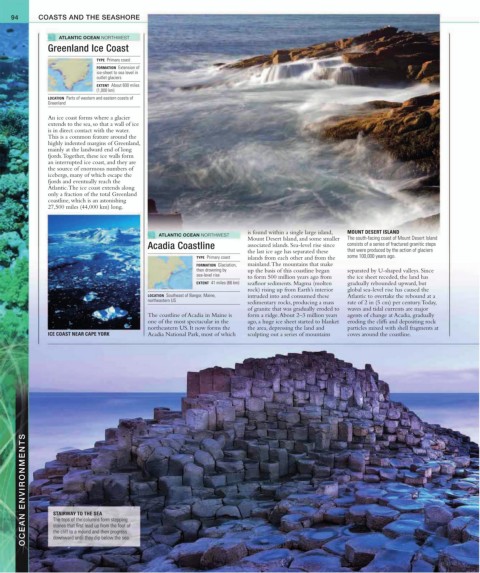
        OCEAN ENVIRONMENTS  STAIRWAY TO THE SEA


                 The tops of the columns form stepping
                 stones that first lead up from the foot of
                 the cliff to a mound and then progress
                 downward until they dip below the sea.

