


Page 29 - (DK Eyewitness) Travel Guide - Belgium & Luxembourg
P. 29
a por tr ait of bel gium and l uxembourg 27
Navez (1787–1869) intro- Surrealism
duced Neo-Classicism to
Flemish art. Brussels-based The 20th century began with
Antoine Wiertz (1806–65) the emergence of Fauvism,
was considered a Romantic, as reflected in the charming
but is also known for pro- portraits of Rik Wouters
ducing melodramatic works, (1882–1916), filled with bright
such as the Inhumation counter-intuitive colour.
Précipitée (c.1830). Realism Surrealism arrived in
took off with Constantin Brussels in the mid-1920s,
Meunier (1831–1905), a dominated from the start by
noted sculptor of muscular René Magritte (1898–1967),
coal miners and factory work- who defined his disorientating
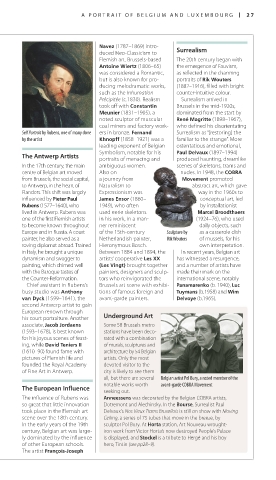
Self Portrait by Rubens, one of many done ers in bronze. Fernand Surrealism as “[restoring] the
by the artist Khnopff (1858–1921) was a familiar to the strange”. More
leading exponent of Belgian ostentatious and emotional,
Symbolism, notable for his Paul Delvaux (1897–1994)
The Antwerp Artists portraits of menacing and produced haunting, dreamlike
In the 17th century, the main ambiguous women. scenes of skeletons, trams and
centre of Belgian art moved Also on nudes. In 1948, the COBRA
from Brussels, the social capital, a journey from Movement pro moted
to Antwerp, in the heart of Naturalism to abstract art, which gave
Flanders. This shift was largely Expressionism was way in the 1960s to
influenced by Pieter Paul James Ensor (1860– conceptual art, led
Rubens (1577–1640), who 1949), who often by installation ist
lived in Antwerp. Rubens was used eerie skeletons Marcel Broodthaers
one of the first Flemish artists in his work, in a man- (1924–76), who used
to become known throughout ner reminiscent daily objects, such
Europe and in Russia. A court of the 15th-century Sculpture by as a casserole dish
painter, he also served as a Netherlandish painter, Rik Wouters of mussels, for his
roving diplomat abroad. Trained Hieronymous Bosch. own interpretation.
in Italy, he brought a unique Between 1884 and 1894, the In recent years, Belgian art
dynamism and swagger to artists’ cooperative Les XX has witnessed a resurgence,
painting, which chimed well (Les Vingt) brought together and a number of artists have
with the Baroque tastes of painters, designers and sculp- made their mark on the
the Counter-Reformation. tors who reinvigorated the international scene, notably
Chief assistant in Rubens’s Brussels art scene with exhibi- Panamarenko (b. 1940), Luc
busy studio was Anthony tions of famous foreign and Tuymans (b.1958) and Wim
van Dyck (1599–1641), the avant-garde painters. Delvoye (b.1965).
second Antwerp artist to gain
European renown through
his court portraiture. Another Underground Art
associate, Jacob Jordaens Some 58 Brussels metro
(1593–1678), is best known stations have been deco-
for his joyous scenes of feast- rated with a combination
ing, while David Teniers II of murals, sculptures and
(1610–90) found fame with architecture by 54 Belgian
pictures of Flemish life and artists. Only the most
founded the Royal Academy devoted visitor to the
of Fine Art in Antwerp. city is likely to see them
all, but there are several Belgian artist Pol Bury, a noted member of the
nota ble works worth avant-garde COBRA Movement
The European Influence
seeking out.
The influence of Rubens was Anneessens was decorated by the Belgian COBRA artists,
so great that little innovation Dotremont and Alechinsky. In the Bourse, Surrealist Paul
took place in the Flemish art Delvaux’s Nos Vieux Trams Bruxellois is still on show with Moving
scene over the 18th century. Ceiling, a series of 75 tubes that move in the breeze, by
In the early years of the 19th sculptor Pol Bury. At Horta station, Art Nouveau wrought-
century, Belgian art was large- iron work from Victor Horta’s now destroyed People’s Palace
ly dominated by the influence is displayed, and Stockel is a tribute to Hergé and his boy
of other European schools. hero, Tintin (see pp28–9).
The artist François-Joseph
026-027_EW_Belgium.indd 27 16/10/14 3:35 pm

