


Page 36 - (DK Eyewitness) Travel Guide - Belgium & Luxembourg
P. 36
34 Introduc I ng bel g I um and l uxembourg
Castles and Châteaux
belgium has the distinction of having more castles in a given
area than any other country in europe. luxembourg might
come a close second. these castles range from romantic
medieval ruins and stern fortresses built for defence, to the
19th-century fantasy palaces of the super-rich. today, many of
the grander châteaux remain in private hands. However, there
are plenty that admit visitors on a regular basis, providing a
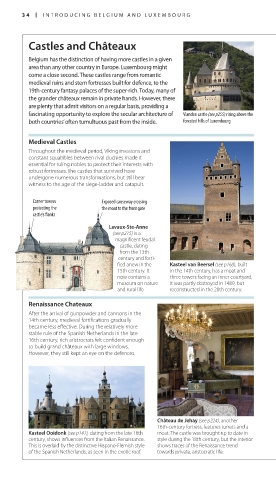
fascinating opportunity to explore the secular architecture of Vianden castle (see p255) rising above the
both countries’ often tumultuous past from the inside. forested hills of Luxembourg
Medieval Castles
Throughout the medieval period, Viking invasions and
constant squabbles between rival duchies made it
essential for ruling nobles to protect their interests with
robust fortresses. The castles that survived have
undergone numer ous transformations, but still bear
witness to the age of the siege-ladder and catapult.
Corner towers Exposed causeway crossing
protecting the the moat to the front gate
castle’s flanks
Lavaux-Ste-Anne
(see p215) is a
magnificent feudal
castle, dating
from the 13th
century and forti-
fied anew in the Kasteel van Beersel (see p168), built
15th century. It in the 14th century, has a moat and
now con tains a three towers facing an inner court yard.
museum on nature It was partly destroyed in 1489, but
and rural life. reconstructed in the 20th century.
Renaissance Chateaux
After the arrival of gunpowder and cannons in the
14th century, medieval fortifications gradually
became less effective. During the relatively more
stable rule of the Spanish Netherlands in the late
16th century, rich aristrocrats felt confident enough
to build grand châteaux with large win dows.
However, they still kept an eye on the defences.
Château de Jehay (see p224), another
16th-century fortress, features turrets and a
Kasteel Ooidonk (see p141), dating from the late 16th moat. The castle was brought up to date in
century, shows influences from the Italian Renaissance. style during the 18th century, but the interior
This is overlaid by the distinctive Hispano-Flemish style shows traces of the Renaissance trend
of the Spanish Netherlands, as seen in the exotic roof. towards private, aristocratic life.
034-035_EW_Belgium.indd 34 16/10/14 3:33 pm
Eyewitness Travel LAYERS PRINTED:
Feature template “UK” LAYER
(SourceReport v1.3)
Date 18th October 2012
Size 125mm x 217mm

