


Page 37 - (DK Eyewitness) Travel Guide - Belgium & Luxembourg
P. 37
a por tr ait of bel gium and l uxembourg 35
17th-Century Fortresses
Armies in this era often adapted medieval castles for
defence against powerful artillery. A key figure was the
French military architect Marquis de Vauban, who
travelled through the Low Countries with Louis XIV’s
forces. He upgraded the castles of Namur and Bouillon,
which had military roles into the 20th century.
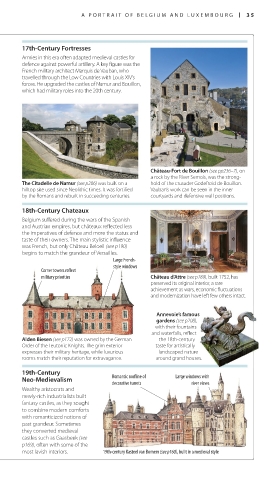
Château-Fort de Bouillon (see pp236–7), on
a rock by the River Semois, was the strong
The Citadelle de Namur (see p206) was built on a hold of the crusader Godefroid de Bouillon.
hilltop site used since Neolithic times. It was fortified Vauban’s work can be seen in the inner
by the Romans and rebuilt in succeeding centuries. courtyards and defensive wall positions.
18th-Century Chateaux
Belgium suffered during the wars of the Spanish
and Austrian empires, but châteaux reflected less
the imperatives of defence and more the status and
taste of their owners. The main stylistic influence
was French, but only Château Beloeil (see p190)
begins to match the grandeur of Versailles.
Large French-
style windows
Corner towers reflect
military priorities Château d’Attre (see p189), built 1752, has
preserved its original interior, a rare
achievement as wars, economic fluctuations
and modernization have left few others intact.
Annevoie’s famous
gardens (see p208),
with their fountains
and waterfalls, reflect
Alden Biesen (see p172) was owned by the German the 18thcentury
Order of the Teutonic Knights. The grim exterior taste for artistically
expresses their military heritage, while luxurious landscaped nature
rooms match their reputation for extravagance. around grand houses.
19th-Century
Neo-Medievalism Romantic roofline of Large windows with
decorative turrets river views
Wealthy aristocrats and
newlyrich industrialists built
fantasy castles, as they sought
to com bine modern comforts
with romanticized notions of
past grandeur. Sometimes
they con verted medieval
castles such as Gaasbeek (see
p169), often with some of the
most lavish interiors. 19th-century Kasteel van Bornem (see p160), built in a medieval style
034-035_EW_Belgium.indd 35 16/10/14 3:33 pm

