


Page 34 - (DK Eyewitness) Travel Guide - Belgium & Luxembourg
P. 34
32 I NTRoduCING BE l GI u m AN d lu x E m B ouRG
Architecture
Throughout its history, Belgium’s international bonds have
linked it to the changing trends of European architecture. It was
first influenced by Romans, then by the Christian Church and
later by styles from across trans-European trade routes. Belgian
architecture mirrored trends in Italy and France, moving from
Romanesque through Gothic to Baroque and Neo-Classical.
However, it always added its own distinctive touches, as seen in
the robust muscularity of Scheldt Gothic, in the graceful Brabant
Gothic and in the Flamboyant Gothic of town halls. In the 1890s,
Belgian architects pioneered the Art Nouveau style.
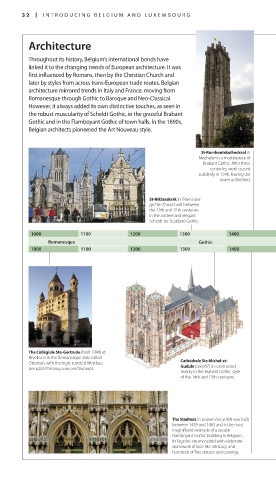
St-Romboutskathedraal in
Mechelen is a masterpiece of
Brabant Gothic. After three
centuries, work ceased
suddenly in 1546, leaving the
tower unfinished.
St-Niklaaskerk in Ghent (see
pp136–7) was built between
the 13th and 15th centuries
in the austere and elegant
Scheldt (or Scaldian) Gothic.
1000 1100 1200 1300 1400 1500
Romanesque Gothic
1000 1100 1200 1300 1400 1500
The Collégiale Ste-Gertrude (built 1046) at
Nivelles is in the Romanesque style called
Ottonian, with the high, tur reted Westbau Cathédrale Sts-Michel-et-
(see p203) forming a second transept. Gudule (see p67) is constructed
mainly in the Brabant Gothic style
of the 14th and 15th centuries.
The Stadhuis in Leuven (see p164) was built
between 1439 and 1463 and is the most
magnificent example of a secular
Flamboyant Gothic building in Belgium.
Its façades are encrusted with elaborate
stonework of lace-like intricacy, and
hundreds of fine statues and carvings.
032-033_EW_Belgium.indd 32 16/10/14 3:35 pm
Eyewitness Travel LAYERS PRINTED:
Feature template “UK” LAYER
(SourceReport v1.3)
Date 18th October 2012
Size 125mm x 217mm

