


Page 33 - (DK Eyewitness) Travel Guide - Belgium & Luxembourg
P. 33
A POR TR AIT OF BEL g I u m A n d L ux E m BO u R g 31
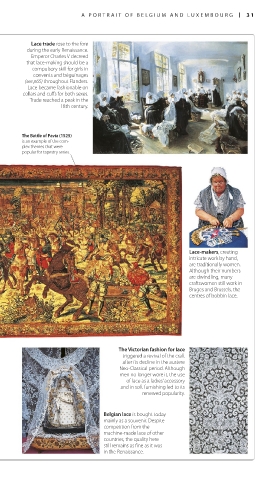
Lace trade rose to the fore
during the early Renaissance.
Emperor Charles V decreed
that lace-making should be a
compulsory skill for girls in
convents and béguinages
(see p65) throughout Flanders.
Lace became fashion able on
collars and cuffs for both sexes.
Trade reached a peak in the
18th century.
The Battle of Pavia (1525)
is an example of the com-
plex themes that were
popular for tapestry series.
Lace-makers, creating
intricate work by hand,
are traditionally women.
Although their numbers
are dwindling, many
craftswomen still work in
Bruges and Brussels, the
centres of bobbin lace.
The Victorian fashion for lace
triggered a revival of the craft
after its decline in the austere
Neo-Classical period. Although
men no longer wore it, the use
of lace as a ladies’ accessory
and in soft furnishing led to its
renewed popularity.
Belgian lace is bought today
mainly as a souvenir. Despite
competition from the
machine-made lace of other
countries, the quality here
still remains as fine as it was
in the Renaissance.
030-031_EW_Belgium.indd 31 16/10/14 3:33 pm

