


Page 30 - (DK Eyewitness) Travel Guide - Krakow
P. 30
28 INTRODUCING KR AK OW
Renaissance Krakow
Krakow, the capital city, developed rapidly in the 16th century
and began to change in appearance. The Cloth Hall, the city
landmark, was remodelled in the Renaissance style, and the
rich merchants of Krakow also began to modernize their
houses. The art and culture of the Italian Renaissance was
assimilated by the royal courts of King Aleksander and
King Zygmunt the Old and his second wife Bona Sforza. Extent of the City
Bartolomeo Berrecci, Giovanni Maria Padovano and other 1572 Today
outstanding Italian masters established their workshops
in Krakow during this time.
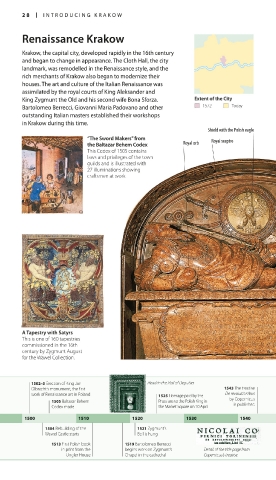
Shield with the Polish eagle
“The Sword Makers” from Royal sceptre
the Baltazar Behem Codex Royal orb
This Codex of 1505 contains
laws and privileges of the town
guilds and is illustrated with
27 illuminations showing
craftsmen at work.
A Tapestry with Satyrs
This is one of 160 tapestries
commissioned in the 16th
century by Zygmunt August
for the Wawel Collection.
1502–5 Erection of King Jan Head in the Hall of Deputies
Olbracht’s monument, the first 1543 The treatise
work of Renaissance art in Poland 1525 Homage paid by the De revolutionibus
1505 Baltazar Behem Prussians to the Polish King in by Copernicus
Codex made the Market Square on 10 April is published
1500 1510 1520 1530 1540
1504 Rebuilding of the 1521 Zygmunt’s
Wawel Castle starts Bell is hung
1513 First Polish book 1519 Bartolomeo Berrecci
in print from the begins work on Zygmunt’s Detail of the title page from
Ungler House Chapel in the cathedral Copernicus’s treatise

