


Page 40 - (DK Eyewitness) Travel Guide - Krakow
P. 40
38 INTRODUCING KR AK OW
Krakow after 1945
After World War II ended Krakow did not willingly accept the new
Soviet-imposed regime. In 1946 the celebrations of the 3 May
Constitution turned into clashes with tragic consequences. Many
Krakovians claim that the industrial suburb of Nowa Huta, with its
immense steelworks (see p156), was built to “punish” the city for
rejecting the 1946 Communist referendum. In fact, the site was
chosen because of good rail links, proximity to the river, and
Krakow’s engineering and scientific heritage. It is also false to
claim that pollution from Nowa Huta was meant to damage
Krakow’s ancient monuments. Krakow’s problem with air quality is
largely the result of domestic heating furnaces and vehicle fumes.
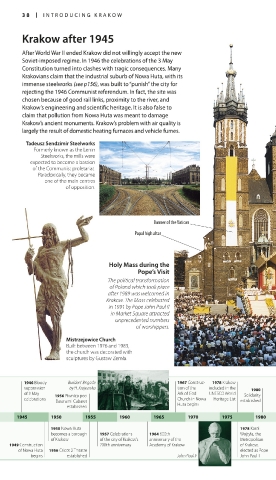
Tadeusz Sendzimir Steelworks
Formerly known as the Lenin
Steelworks, the mills were
expected to become a bastion
of the Communist proletariat.
Paradoxically, they became
one of the main centres
of opposition.
Banner of the Vatican
Papal high altar
Holy Mass during the
Pope’s Visit
The political transformation
of Poland which took place
after 1989 was welcomed in
Krakow. The Mass celebrated
in 1991 by Pope John Paul II
in Market Square attracted
unprecedented numbers
of worshippers.
Mistrzejowice Church
Built between 1976 and 1983,
the church was decorated with
sculptures by Gustaw Zemła.
1946 Bloody Builders’ Brigade 1967 Construc- 1978 Krakow
suppression by H. Krajewska tion of the included in the 1980
of 3 May 1956 Piwnica pod Ark of God UNESCO World Solidarity
celebrations Church in Nowa Heritage List
Baranami Cabaret established
established Huta begins
1945 1950 1955 1960 1965 1970 1975 1980
1950 Nowa Huta 1978 Karol
becomes a borough 1957 Celebrations 1964 600th Wojtyła, the
of Krakow of the city of Krakow’s anniversary of the Metropolitan
1949 Construction 700th anniversary Academy of Krakow of Krakow,
of Nowa Huta 1956 Cricot 2 Theatre elected as Pope
begins established John Paul II John Paul II

