


Page 36 - (DK Eyewitness) Travel Guide - Krakow
P. 36
34 INTRODUCING KR AK OW
Modernist Krakow
At the end of the 19th century Greater Krakow was
established and became a place of mass excursions from
other parts of occupied Poland. People came to see the
newly re-established university and the repossessed Wawel,
which was then undergoing restoration. It was the period
of “art for art’s sake”, and Krakow became a mecca for Polish
artists. Modern life concentrated around artistic cafés, such Extent of the City
as the Paon and the Jama Michalika, which were also venues 1900 Today
for cabarets. The latter café housed the Zielony Balonik
Cabaret. The ambience in Krakow was one of melancholy and
decadence but life, permeated by patriotic Neo-Romantic The cathedral
symbolism, was lived here to the full. The outbreak of World
War I put an end to this unique bohemian era.
House of Deputies of
the new Parliament
Academies
and museums
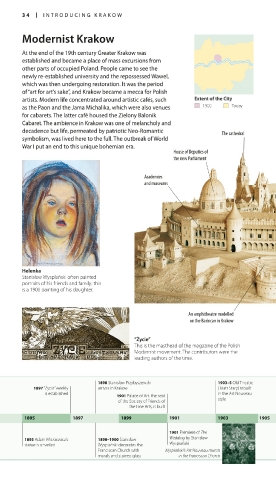
Helenka
Stanisław Wysplański often painted
portraits of his friends and family; this
is a 1900 painting of his daughter.
An amphitheatre modelled
on the Barbican in Krakow
“Życie”
This is the masthead of the magazine of the Polish
Modernist movement. The contributors were the
leading authors of the time.
1898 Stanisław Przybyszewski 1903–5 Old Theatre
1897 “Życie” weekly arrives in Krakow (Teatr Stary) rebuilt
is established in the Art Nouveau
1901 Palace of Art, the seat
of the Society of Friends of style
the Fine Arts, is built
1895 1897 1899 1901 1903 1905
1901 Premiere of The
1895 Adam Mickiewicz’s 1898–1900 Stanisław Wedding by Stanisław
statue is unveiled Wyspiański decorates the Wyspiański
Franciscan Church with Wyspiański’s Art Nouveau murals
murals and stained glass in the Franciscan Church

