


Page 38 - (DK Eyewitness) Travel Guide - Krakow
P. 38
36 INTRODUCING KR AK OW
Krakow in the Years 1918–1945
When World War I ended in 1918, Poland regained its
independence after 123 years of foreign occupation. In
the period between the two World Wars Krakow provided
political leaders, bureaucrats and army officers to the
new Polish Republic. Above all the city was a cultural and
academic centre. Art Nouveau traditions were still present
in the arts but soon gave way to a new generation of artists, Extent of the City
such as the Formists, Capists (the Polish variant of Post- 1938 Today
Impressionists), the avant-garde Krakow Group and the
Cricot Theatre. During World War II the German Governor
General had his headquarters in Krakow, and this was Kościuszko Mound
reason enough for the city to be spared destruction.
Marshal Józef
Piłsudski
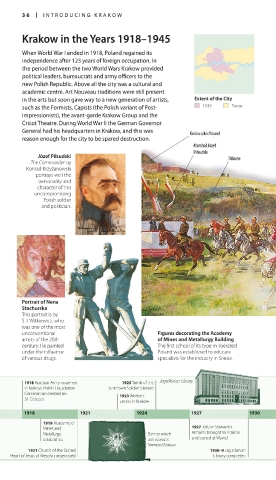
Józef Piłsudski Tribune
The Commander by he Commander by he Commander
T T
Konrad Krzyżanowski
portrays well the
personality and
character of this
uncompromising
Polish soldier
and politician.
Portrait of Nena
Stachurska
This portrait is by
S. I. Witkiewicz, who
was one of the most
unconventional Figures decorating the Academy
artists of the 20th of Mines and Metallurgy Building
century. He painted The first school of its type in liberated
under the influence Poland was established to educate
of various drugs. specialists for the industry in Silesia.
1918 Austrian Army disarmed 1925 Tomb of the Jagiellonian Library
in Krakow. Polish Liquidation Unknown Soldier blessed
Commission created on 1923 Workers’
31 October
unrest in Krakow
1918 1921 1924 1927 1930
1919 Academy of
Mines and 1927 Juliusz Słowacki’s
Metallurgy Banner which remains brought to Krakow
established was raised in and buried at Wawel
liberated Krakow
1921 Church of the Sacred 1930–9 Jagiellonian
Heart of Jesus at Wesoła consecrated Library completed

