


Page 35 - Flight International (January 2020)
P. 35
ENVIRONMENT


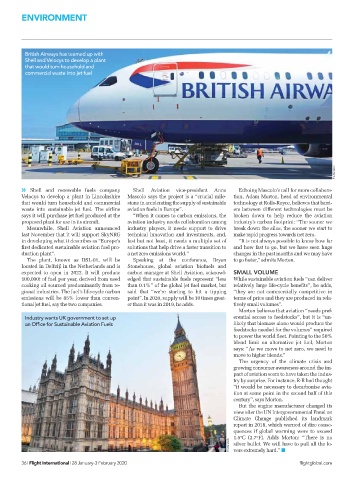
          British Airways has teamed up with
          Shell and Velocys to develop a plant
          that would turn household and
          commercial waste into jet fuel


                                                                                                                    Shutterstock


        ❯❯ Shell and renewable fuels company   Shell  Aviation  vice-president  Anna  Echoing Mascolo’s call for more collabora-
        V elocys to develop a plant in Lincolnshire     Mascolo says the project is a “crucial mile-  tion, Adam Morton, head of environmental
        that would turn household and commercial   stone in accelerating the supply of sustainable   technology at Rolls-Royce, believes that barri-
        waste into sustainable jet fuel. The airline   aviation fuels in Europe”.  ers between different technologies must be
        says it will purchase jet fuel produced at the   “When it comes to carbon emissions, the   broken down to help reduce the aviation
        proposed plant for use in its aircraft.  aviation industry needs collaboration among     industry’s carbon footprint: “The sooner we
          Meanwhile, Shell Aviation announced   industry players, it needs support to drive   break down the silos, the sooner we start to
        last November that it will support SkyNRG   technical innovation and investments, and,   make rapid progress towards net zero.
        in developing what it describes as “Europe’s   last but not least, it needs a multiple set of   “It is not always possible to know how far
        first dedicated sustainable aviation fuel pro-    solutions that help drive a faster transition to   and how fast to go, but we have seen huge
        duction plant”.                      a net zero emissions world.”        changes in the past months and we may have
          The plant, known as DSL-01, will be   Speaking at the conference, Bryan   to go faster,” admits Morton.
        located in Delfzijl in the Netherlands and is     Stonehouse, global aviation biofuels and
        expected to open in 2022. It will produce     carbon manager at Shell Aviation, acknowl-  SMALL VOLUME
        100,000t of fuel per year, derived from used   edged that sustainable fuels represent “less   While sustainable aviation fuels “can deliver
        cooking oil sourced predominantly from re-  than 0.1%” of the global jet fuel market, but   relatively large life-cycle benefits”, he adds,
        gional industries. The fuel’s life-cycle carbon   said that “we’re starting to hit a tipping   “they are not commercially competitive in
        emissions will be 85% lower than conven-  point”. In 2020, supply will be 10 times great-  terms of price and they are produced in rela-
        tional jet fuel, say the two companies.  er than it was in 2019, he adds.  tively small volumes”.
                                                                                   Morton believes that aviation “needs pref-
          Industry wants UK government to set up                                 erential access to feedstocks”, but it is “un-
          an Office for Sustainable Aviation Fuels                                likely that biomass alone would produce the
                                                                                 feedstocks needed for the volumes” required
                                                                                 to power the world fleet. Pointing to the 50%
                                                                                 blend limit on alternative jet fuel, Morton
                                                                                 says: “As we move to net zero, we need to
                                                                                 move to higher blends.”
                                                                                   The urgency of the climate crisis and
                                                                                   growing consumer awareness around the im-
                                                                                 pact of aviation seem to have taken the indus-
                                                                                 try by surprise. For instance, R-R had thought
                                                                                 “it would be necessary to decarbonise avia-
                                                                                 tion at some point in the second half of this
                                                                                 century”, says Morton.
                                                                                   But the engine manufacturer changed its
                                                                                 view after the UN Intergovernmental Panel on
                                                                                 Climate Change published its landmark
                                                                                   report in 2018, which warned of dire conse-
                                                                                 quences if global warming were to exceed
                                                                                Shutterstock 1.5°C (2.7°F). Adds Morton: “There is no
                                                                                   silver bullet. We will have to pull all the le-
                                                                                 vers extremely hard.” ■


        36  |  Flight International  |  28 January-3 February 2020                                      flightglobal.com

