


Page 31 - Flight International (January 2020)
P. 31
ROTORCRAFT


        ❯❯  of MCAS is widely seen as having   teer information to the FAA such as a detailed     traditional helicopter, should be its noise goal
        played a role.                       architecture of the Nexus 4EX’s propulsion   for the Nexus 4EX.
          The FAA has not formalised regulations for   and flight-control systems, as well as its relat-  “Bell will strive for the lowest holistic
        certificating eVTOL aircraft or rules for intra-  ed safety analysis.     noise considering not only loudness (deci-
        city autonomous flights. To help flush out   In addition to public and regulatory confi-  bels), but also tone, ambient noise and com-
          operating procedures and flight rules, Bell   dence in safety, Bell believes reducing the   munity noise tolerance,” says Drennan,
        was contracted last year by NASA to conduct   amount of noise produced by its eVTOL air-  noting that people in some cities may accept
        flights using its Autonomous Pod Transport   craft will play a crucial role in encouraging   less sound than those in other regions.
        70 cargo drone. The company is to conduct   people to accept hundreds or thousands of   “Noise is too critically linked to
        demonstrations in the Dallas-Fort Worth,   aircraft buzzing overhead. The company     performance and cost to set an arbitrary
        Texas airspace in the summer of 2020.  thinks that a decibel level in the high 70s or   loudness level that doesn’t take all of these
          The company also says it is ready to volun-  low 80s, about 15 decibels quieter than a   factors into account.” ■


          TECHNOLOGY
          Helicopter maker charges artificial intelligence with managing eVTOL operations
          In a partial break with its partner Uber – as well
          as its own historical business model – Bell
          plans to vertically integrate aircraft production,
          flight operations and nearly everything in be-
          tween, in a bid to grab a large piece of the
          nascent electric vertical take-off and landing
          (eVTOL) air taxi industry. The helicopter and
          tiltrotor manufacturer believes that the volume
          of eVTOL air taxi flights to come in the future
          will require closely co-ordinated, vertically
            integrated companies to ensure passenger
          safety and corporate profitability.
           The company is pushing headlong into
            software development of a variety of applica-
          tions to synchronise a tall order of business
            operations. At January’s Consumer Electronics
          Show in Las Vegas, it  announced the first step
          in that effort; a software program named AerOS
          is to be a platform for a larger suite of eVTOL
          support software, including master scheduling                                                           Shutterstock
          and real-time aircraft monitoring. The company
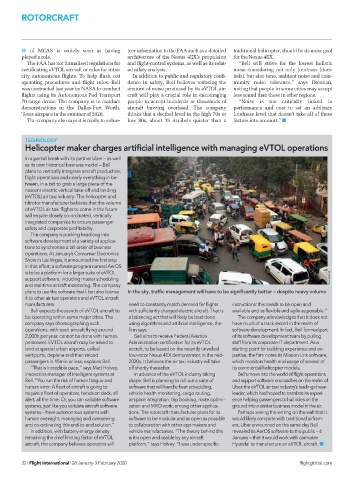
          plans to use the software itself, but also license   In the sky, traffic management will have to be significantly better – despite heavy volume
          it to other air taxi operators and eVTOL aircraft
          manufacturers.                     need to constantly match demand for flights   instructions: this needs to be open and
           Bell expects thousands of eVTOL aircraft to   with sufficiently charged electric aircraft. That is     available and as flexible and agile as possible.”
          be operating within some major cities. The   a balancing act that will likely be best done   The company acknowledges that it does not
          company says choreographing such     using algorithms and artificial intelligence, the   have much of a track record in the realm of
            operations, with each aircraft flying around   firm says.                software development. In fact, Bell formed part
          2,000h per year, cannot be done with human   Bell aims to receive Federal Aviation   of its software development team by pulling
          personnel. EVTOL aircraft may be asked to   Administration certification for its eVTOL   staff from its corporate IT department. As a
          land at special urban airports, called     aircraft, to be based on the recently unveiled   starting point for building experience and ex-
            vertiports, deplane and then  reload   four-rotor Nexus 4EX demonstrator, in the mid-  pertise, the firm notes its Mission Link software,
            passengers in 15min or less,  explains Bell.  2020s. It believes the air taxi industry will take   which  monitors health and usage of several of
           “That is incredible pace,” says Matt Holvey,   off shortly thereafter.  its  commercial helicopter models.
          innovation manager of intelligent systems at   In advance of the eVTOL industry taking   Bell’s move into the world of flight operations
          Bell. “You run the risk of human fatigue and   shape, Bell is planning to roll out a suite of   and support software encroaches on the realm of
            human error. A fleet of aircraft is going to     software that will handle fleet scheduling,   Uber, the eVTOL air taxi industry’s leading cheer-
            require a fleet of operators, hands on deck, all     vehicle health monitoring, cargo routing,   leader, which had hoped to translate its experi-
          alert, all the time. Or, you can validate software     airspace integration, trip booking, route optimi-  ence helping passengers to hail rides on the
          systems, just like you validate aircraft software   sation and MRO work, among other applica-  ground into a similar business model in the air.
          systems – have autonomous systems with   tions. The rotorcraft manufacturer plans for its   Perhaps seeing the writing on the wall that it
            human oversight, managing and overseeing   software to be modular and as open as possible   would likely compete with traditional airfram-
          and co-ordinating this end-to-end solution.”  to collaboration with other app makers and   ers, Uber announced on the same day Bell
           In addition, with battery energy density     vehicle manufacturers. “The theory behind this     revealed its AerOS software to the public – 6
            remaining the chief limiting factor of eVTOL   is it is open and usable by any aircraft   January – that it would work with carmaker
            aircraft, the company believes operators will     platform,” says Holvey. “I was under specific   Hyundai to manufacture an eVTOL aircraft. ■


        32  |  Flight International  |  28 January-3 February 2020                                      flightglobal.com

