


Page 33 - Flight International (January 2020)
P. 33
ENVIRONMENT


        Are biofuels


        the future?


        Aviation is one of the hardest industries to decarbonise – not
        least because demand for air travel is likely to increase – but
        political backing for sustainable fuels could have a big impact


                                               “The target for 2050 should be a 100% re-
        KERRY REALS LONDON
                                             duction,” says Turner, adding that this should
               ommercial flights could be fully   be “possible” to achieve without relying on
               powered by low-carbon fuels by   carbon offsetting. The route should instead
               2050, according to the former chair   involve electrification of short-haul flights
        C of the UK Committee on Climate     and a shift to 100% drop-in low-carbon fuels
        Change, but only if the right regulatory frame-  for long-haul flights, he adds.
        works are put in place and airlines accept the   As things stand, aircraft electrification
        cost penalty, in addition to agreeing to buy   efforts are still in their infancy and the use of   Europe. This could increase aviation emis-
        sufficient volumes to enable production to be   sustainable aviation fuel (SAF) is restricted   sions by 83% by 2050 in a business-as-usual
        scaled up.                           both by a 50% blend limit with conventional   scenario,” he warns.
          In a keynote speech at the Royal Aero-  jet fuel and negligible supplies. Biofuels cur-  “This is a sector where we don’t see enor-
        nautical Society’s Greener by Design confer-  rently represent less than 1% of the world’s   mous potential to reduce demand. Yes, you
        ence in London in early November, Lord   total jet fuel supply. Nevertheless, the avia-  can shift short routes to rail; yes, you can
        Adair Turner, who now chairs the Energy   tion industry has “got to do something radi-  video conference; yes, you can have higher
        Transitions Commission (ETC) – a group   cal” to address its growing emissions prob-  prices; and yes, you can have better air traffic
        specialising in the decarbonisation of hard-to-  lem, Turner believes.   management – but it’s difficult to believe you
        abate sectors – also urged the airline industry                          can reduce demand by more than 15%.
        to set more ambitious carbon dioxide (CO2)   MORE FLYING                 There’s some mileage there but it’s not the
        emissions reduction goals.           “Aviation is going to be a tricky sector of the   complete answer.”
          The target set by IATA a decade ago calls   economy [to decarbonise] because demand is   Switching over to alternative fuels will be
        for a 50% reduction in net aviation CO2 emis-  very likely to increase. Once people get to a   expensive, however, with biofuels costing up
        sions by 2050, relative to 2005 levels, and   middle income, one of the things they want to   to three times more than conventional kero-
        carbon-neutral growth from 2020.     do is fly as much as they do in [the USA] and   sene. But as the ETC points out in a 2018 re-
                                                                                 port on decarbonising aviation, the addition-
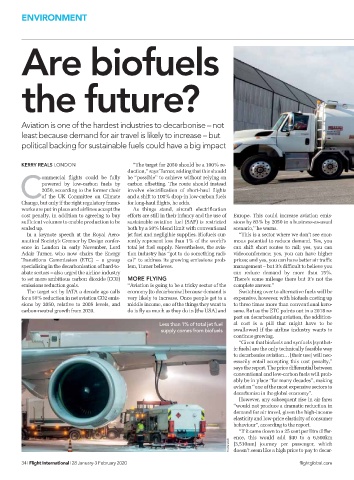
                                                        Less than 1% of total jet fuel   al cost is a pill that might have to be
                                                        supply comes from biofuels  swallowed if the airline industry wants to
                                                                                 continue growing.
                                                                                   “Given that biofuels and synfuels [synthet-
                                                                                 ic fuels] are the only technically feasible way
                                                                                 to decarbonise aviation… [their use] will nec-
                                                                                 essarily entail accepting this cost penalty,”
                                                                                 says the report. The price differential between
                                                                                 conventional and low-carbon fuels will prob-
                                                                                 ably be in place “for many decades”, making
                                                                                 aviation “one of the most expensive sectors to
                                                                                 decarbonise in the global economy”.
                                                                                   However, any subsequent rise in air fares
                                                                                 “would not produce a dramatic reduction in
                                                                                 demand for air travel, given the high-income
                                                                                 elasticity and low-price elasticity of consumer
                                                                                 behaviour”, according to the report.
                                                                                   “If it came down to a 25 cent per litre differ-
                                                                                 ence, this would add $40 to a 6,500km
                                                                                Shutterstock  [3,510nm] journey per passenger, which
                                                                                 doesn’t seem like a high price to pay to decar-


        34  |  Flight International  |  28 January-3 February 2020                                      flightglobal.com

