


Page 30 - Flight International (January 2020)
P. 30
BELL NEXUS 4EX


          focused on moving passengers as efficiently
        as possible from point to point.
          The Nexus 4EX is to have a maximum gross
        take-off weight of about 3,200kg (7,050lb) and a
        cruise speed of 130kt (241km/h).
          Based on conversations and surveys of po-
        tential customers and stakeholders, such as
        ride-share companies, as well as city, state
        and national governments, the company esti-
        mates flights on average would be 13-22nm
        in length.
          Each aircraft is likely to operate for 2,000h
        per year, the company says.
          Bell believes hundreds to thousands of
        eVTOL aircraft would be needed within a
        city to significantly change traffic patterns on
        the roads.
          The company declines to say how many
        aircraft would be required to reach profitabil-
        ity, noting its analysis is ongoing, but it
          expects that eVTOL aircraft would be pri-
        marily used for faster ride-share, public
        transportation and cost-sensitive traditional
        helicopter applications.
          At least in the beginning, Bell does not ex-
        pect eVTOL aircraft to stimulate travel demand
        – in other words, trips people would not take if
        they did not have access to the speed and range
        of the aircraft. Rather, early users will likely fly
        out of curiosity or as an experiment. Gradually,   Shutterstock
        the company expects the aircraft to become a
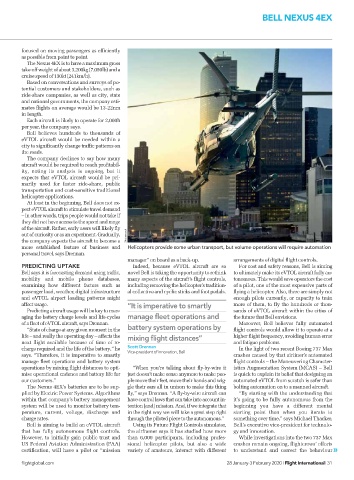
        more established feature of business and   Helicopters provide some urban transport, but volume operations will require automation
          personal travel, says Drennan.
                                             manager” on board as a back-up.     arrangements of digital flight controls.
        PREDICTING UPTAKE                      Indeed, because eVTOL aircraft are so   For cost and safety reasons, Bell is aiming
        Bell says it is forecasting demand using traffic,   novel Bell is taking the opportunity to rethink   to ultimately make its eVTOL aircraft fully au-
        mobility and mobile phone databases,   many aspects of the aircraft’s flight controls,   tonomous. This would save operators the cost
          examining how different factors such as   including removing the helicopter’s tradition-  of a pilot, one of the most expensive parts of
          passenger load, weather, digital infrastructure   al collective and cyclic sticks and foot pedals.  flying a helicopter. Also, there are simply not
        and eVTOL airport loading patterns might                                 enough pilots currently, or capacity to train
          affect usage.                      “It is imperative to smartly        more of them, to fly the hundreds or thou-
          Predicting aircraft usage will be key to man-                          sands of eVTOL aircraft within the cities of
        aging the battery charge levels and life-cycles  manage fleet operations and  the future that Bell envisions.
        of a fleet of eVTOL aircraft, says Drennan.                                 Moreover, Bell believes fully automated
          “State of charge at any given moment in the   battery system operations by  flight controls would allow it to operate at a
        life – and really the operating day – affects the   mixing flight distances”  higher flight frequency, avoiding human error
        next flight available because of time of re-                              and fatigue problems.
        charge required and the life of the battery,” he   Scott Drennan           In the light of two recent Boeing 737 Max
        says. “Therefore, it is imperative to smartly   Vice-president of innovation, Bell  crashes caused by that airliner’s automated
        manage fleet operations and battery system                                flight controls – the Maneuvering Character-
        operations by mixing flight distances to opti-  “When you’re talking about fly-by-wire it   istics Augmentation System (MCAS) – Bell
        mise operational cadence and battery life for   just doesn’t make sense anymore to make peo-  is quick to explain its belief that designing an
        our customers.”                      ple move their feet, move their hands and wig-  automated eVTOL from scratch is safer than
          The Nexus 4EX’s batteries are to be sup-  gle their ears all in unison to make this thing   bolting automation on to a manned aircraft.
        plied by Electric Power Systems. Algorithms   fly,” says Drennan. “A fly-by-wire aircraft can   “By starting with the understanding that
        within that company’s battery management   have control laws that can take into account in-  it’s going to be fully autonomous from the
        system will be used to monitor battery tem-  tention [and] mission. And, if we integrate that     beginning you have a different mental
        perature, current, voltage, discharge and   in the right way we will take a great step right     starting point than when you iterate to
        charge rates.                        through the piloted piece to the autonomous.”    something over time,” says Michael Thacker,
          Bell is aiming to build an eVTOL aircraft   Using its Future Flight Controls simulator,   Bell’s executive vice-president for technolo-
        that has fully autonomous flight controls.   the airframer says it has studied how more   gy and innovation.
        However, to initially gain public trust and   than 6,000 participants, including profes-  While investigations into the two 737 Max
        US Federal Aviation Administration (FAA)   sional helicopter pilots, but also a wide   crashes remain ongoing, flightcrews’ efforts
        certification, will have a pilot or “mission     variety of amateurs, interact with different   to understand and correct the behaviour   ❯❯


        flightglobal.com                                                        28 January-3 February 2020  |  Flight International  |  31

