


Page 44 - Amphibian
P. 44
Frog or toad?


        Frogs and toads are the most easily recognized amphibians                                              Smooth
                                                                                                               skin not
        because they have such a distinctive body shape. Separating                                            typical
        this group into “frogs” and “toads” is not so easy, as the                                             in toads
        features used to distinguish between them do not apply
        in all cases. In general, frogs are more active, are found
        in or near water, and have smooth skins, long hind
        legs, and fully webbed feet; toads tend to be less active,
        prefer to live on land, and have dry, warty skins, short
        legs, and little or no webbing. Yet some frogs do not
        live near water and have little or no webbing on
        their feet, and some toads have a smooth skin.
                            The word “frogs” is often used
                              by experts, to include both
                                   frogs and toads.                                                             Disk on
                                                                                                                finger


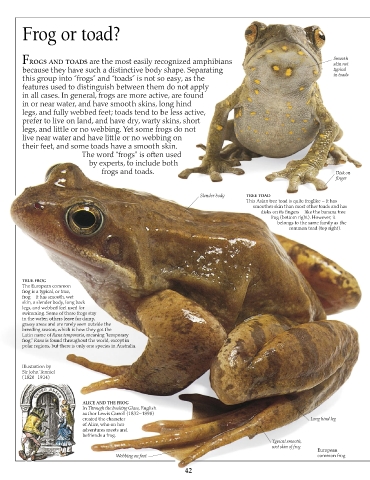
                                                                   Slender body    TREE TOAD
                                                                                   This Asian tree toad is quite froglike – it has
                                                                                     smoother skin than most other toads and has
                                                                                       disks on its fingers – like the banana tree
                                                                                           frog (bottom right). However, it
                                                                                             belongs to the same family as the
                                                                                                 common toad (top right).


        TRUE FROG
        The European common
        frog is a typical, or true,
        frog – it has smooth, wet
        skin, a slender body, long back
        legs, and webbed feet used for
        swimming. Some of these frogs stay
        in the water; others leave for damp,
        grassy areas and are rarely seen outside the
        breeding season, which is how they got the
        Latin name of Rana temporaria, meaning “temporary
        frog.” Rana is found throughout the world, except in
        polar regions, but there is only one species in Australia.


        Illustration by
        Sir John Tenniel
        (1820–1914)


                            ALICE AND THE FROG
                            In Through the hooking Glass, English
                            author Lewis Carroll (1832–1898)
                            created the character                                                       Long hind leg
                            of Alice, who on her
                            adventures meets and
                            befriends a frog.
                                                                                           Typical smooth,
                                                                                           wet skin of frog
                                                                                                          European
                                       Webbing on foot                                                    common frog
                                                              42

