


Page 62 - Amphibian
P. 62
Rare and endangered


        Many species of amphibians are rarely seen because they are secretive,
        like burrowing frogs, or because their natural habitats are inaccessible.
                                                                                                  MORE PRECIOUS THAN GOLD
        Others are seldom found outside a small geographical area. Although                     This 2,000-year-old Chinese gold
        amphibians new to science are still being discovered at the rate of 15 to 25          frog is valuable, but when a species
                                                                                                   disappears, it is gone forever!
        species a year, many others are becoming rarer due to global warming, low
        water levels, pollution, acid rain, and the destruction of their habitats, such
        as the cutting down of rain forests or the filling in of ponds. Preserving
        natural habitats (pp. 62–63) is the most
        important step in preventing
        these fascinating
        animals from
        becoming
        extinct.

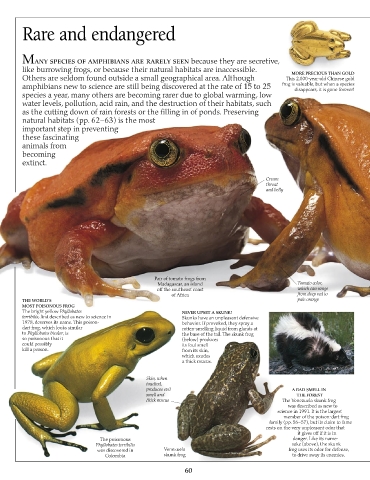
                                                                                         Cream
                                                                                         throat
                                                                                         and belly


                                                    Pair of tomato frogs from
                                                     Madagascar, an island                          Tomato color,
                                                     off the southeast coast                        which can range
                                                          of Africa                                 from deep red to
        THE WORLD’S                                                                                 pale orange
        MOST POISONOUS FROG
        The bright yellow Phyllobates                        NEVER UPSET A SKUNK!
        terribilis, first described as new to science in     Skunks have an unpleasant defensive
        1978, deserves its name. This poison-                behavior. If provoked, they spray a
        dart frog, which looks similar                       rotten-smelling liquid from glands at
        to Phyllobates bicolor, is                           the base of the tail. The skunk frog
        so poisonous that it                                 (below) produces
        could possibly                                       its foul smell
        kill a person.                                       from its skin,
                                                             which exudes
                                                             a thick mucus.


                                                 Skin, when
                                                 touched,
                                                 produces evil                                    A BAD SMELL IN
                                                 smell and                                         THE FOREST
                                                 thick mucus                                  The Venezuela skunk frog
                                                                                                was described as new to
                                                                                             science in 1991. It is the largest
                                                                                               member of the poison-dart frog
                                                                                          family (pp. 56–57), but its claim to fame
                                                                                         rests on the very unpleasant odor that
                                                                                                    it gives off if it is in
                                  The poisonous                                                   danger. Like its name-
                                 Phyllobates terribilis                                           sake (above), the skunk
                                 was discovered in     Venezuela                                 frog uses its odor for defense,
                                    Colombia           skunk frog                                 to drive away its enemies.
                                                               0

