


Page 63 - Amphibian
P. 63
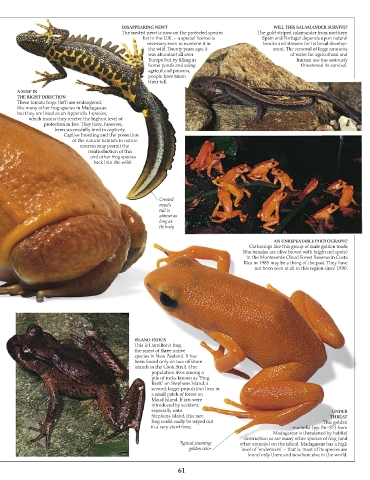
DISAPPEARING NEWT                                  WILL THIS SALAMANDER SURVIVE?
                                         The crested newt is now on the protected species   The gold-striped salamander from northern
                                                list in the U.K. – a special license is   Spain and Portugal depends upon natural
                                                  necessary even to examine it in       brooks and streams for its larval develop-
                                                  the wild. Twenty years ago, it           ment. The removal of large amounts
                                                  was abundant all over                          of water for agricultural and
                                                  Europe but by filling in                         human use has seriously
                                                  home ponds and using                               threatened its survival.
                                                  agricultural poisons,
                                                  people have taken
                                                  their toll.
       A STEP IN
       THE RIGHT DIRECTION
       These tomato frogs (left) are endangered,
       like many other frog species in Madagascar,
       but they are listed as an Appendix I species,
           which means they receive the highest level of
                protection in law. They have, however,
                   been successfully bred in captivity.
                      Captive breeding and the protection
                         of the natural habitats in nature
                           reserves may permit the
                              reintroduction of this
                               and other frog species
                                back into the wild.


                                                      Crested
                                                      newt’s
                                                      tail is
                                                      almost as
                                                      long as
                                                      its body

                                                                                            AN UNREPEATABLE PHOTOGRAPH?
                                                                                   Gatherings like this group of male golden toads
                                                                                 (the females are olive brown with bright red spots)
                                                                                   in the Monteverde Cloud Forest Reserve in Costa
                                                                                  Rica in 1985 may be a thing of the past. They have
                                                                                     not been seen at all in this region since 1990.


                                              ISLAND FROGS
                                              This is Hamilton’s frog,
                                              the rarest of three native
                                              species in New Zealand. It has
                                              been found only on two offshore
                                              islands in the Cook Strait. One
                                                   population lives among a
                                                   pile of rocks known as “Frog
                                                   Bank” on Stephens Island; a
                                                   second, larger population lives in
                                                   a small patch of forest on
                                                   Maud Island. If rats were
                                                   introduced by accident,
                                                   especially onto                                             UNDER
                                                   Stephens Island, this rare                                 THREAT
                                                   frog could easily be wiped out                           This golden
                                                   in a very short time.                          mantella (pp. 56–57) from
                                                                                           Madagascar is threatened by habitat
                                                                                  destruction as are many other species of frog (and
                                                             Typical stunning   other animals) on the island. Madagascar has a high
                                                                golden color     level of “endemism” – that is, most of its species are
                                                                                   found only there and nowhere else in the world.

                                                             1

