


Page 66 - Amphibian
P. 66
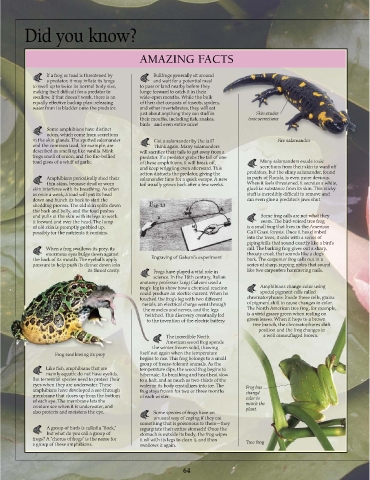
Did you know?


                                               AMAZING FACTS


                If a frog or toad is threatened by   Bullfrogs generally sit around
                a predator, it may inflate its lungs   and wait for a potential meal
            to swell up to twice its normal body size,   to pass or land nearby before they
            making itself difficult for a predator to   lunge forward to catch it in their
            swallow. If that doesn’t work, there is an   wide-open mouths. While the bulk
            equally effective backup plan: releasing   of their diet consists of insects, spiders,
            water from its bladder onto the predator.  and other invertebrates, they will eat
                                               just about anything they can stuff in   Skin exudes
                                               their mouths, including fish, snakes,   toxic secrections
                                               birds—and even entire mice!
                Some amphibians have distinct
                odors, which come from secretions
            in the skin glands. The spotted salamander   Got a salamander by the tail?       Fire salamander
            and the common toad, for example, are   Think again. Many salamanders
            described as smelling like vanilla. Mink   will sacrifice their tails to get away from a
            frogs smell of onion, and the fire-bellied   predator. If a predator grabs the tail of one
            toad gives of a whiff of garlic.   of these amphibians, it will break off,   Many salamanders exude toxic
                                               and keep wriggling even afterward. This   secretions from their skin to ward off
                                               action distracts the predator, giving the   predators, but the slimy salamander, found
                Amphibians periodically shed their   salamander time for a quick escape. A new   in parts of Florida, is even more devious.
                thin skins, because dead or worn   tail usually grows back after a few weeks.  When it feels threatened, it secretes a white,
            skin interferes with its breathing. As often                           gluelike substance from its skin. This sticky
            as once a week, a toad will put its head                               stuff is incredibly difficult to remove and
            down and hunch its back to start the                                   can even glue a predator’s jaws shut.
            shedding process. The old skin splits down
            the back and belly, and the toad pushes
            and pulls at the skin with its legs to work                                Some frog calls are not what they
            it forward and over the head. The lump                                     seem. The bird-voiced tree frog
            of old skin is promptly gobbled up,                                    is a small frog that lives in the American
            possibly for the nutrients it contains.                                Gulf Coast forests. Once it has climbed
                                                                                   into the trees, it calls with a series of
                                                                                   piping trills that sound exactly like a bird’s
                When a frog swallows its prey, its                                 call. The barking frog gives out a sharp,
                enormous eyes bulge down against                                   throaty croak that sounds like a dog’s
            the back of its mouth. The eyeballs apply   Engraving of Galvani’s experiment  bark. The carpenter frog calls out in a
            pressure to help push its dinner down into                             series of sharp, rapping notes that sound
                              its throat cavity.    Frogs have played a vital role in   like two carpenters hammering nails.
                                                    science. In the 18th century, Italian
                                               anatomy professor Luigi Galvani used a
                                               frog’s  leg to show how a chemical reaction   Amphibians change color using
                                               could produce an electric current. When he   special pigment cells called
                                               touched the frog’s leg with two different   chromatorphores. Inside these cells, grains
                                                metals, an electrical charge went through   of pigment shift to cause changes in color.
                                                the muscles and nerves, and the legs   The North American tree frog, for example,
                                                 twitched. This discovery eventually led   is a vivid grassy green when resting on
                                                  to the invention of the electric battery.  green leaves. When it hops to a brown
                                                                                     tree branch, the chromatophores shift
                                                                                       position and the frog changes to
                                                        The incredible North            a well camouflaged brown.
                                                        American wood frog spends
                                                   the winter frozen solid, thawing
                   Frog swallowing its prey    itself out again when the temperature
                                               begins to rise. This frog belongs to a small
                                               group of freeze-tolerant animals. As the
                Like fish, amphibians that are   temperature dips, the wood frog begins to
                mainly aquatic do not have eyelids.   hibernate. Its breathing and heartbeat slow
            But terrestrial species need to protect their   to a halt, and as much as two-thirds of the
            eyes when they are underwater. These   water in its body crystallizes into ice. The
            amphibians have developed a see-through   frog stays frozen for two or three months   Frog has
                                                                                  changd
            membrane that closes up from the bottom   of each winter.             color to
            of each eye. The membrane lets the
                                                                                  match the
            creature see when it is underwater, and                               plant.
            also protects and moistens the eye.     Some species of frogs have an
                                                    unusual way of coping if they eat
                                               something that is poisonous to them—they
                A group of birds is called a “flock,”   regurgitate their entire stomach! Once the
                but what do you call a group of   stomach is outside its body, the frog wipes
            frogs? A “chorus of frogs” is the name for   it off with its legs to clean it, and then
            a group of these amphibians.       swallows it again.                 Tree frog


                                                              64

