


Page 49 - Complete Cat Care: How To Keep Your Cat Healthy and Happy
P. 49
Musculoskeletal disorders


        The musculoskeletal system comprises bones and joints, cartilage and
        connective tissues, and muscles. Common musculoskeletal problems for
        cats are fractures and torn ligaments, but they can also develop arthritis.


          Signs of a problem
          ■ Inability to put weight on a leg
          ■ Crying or hissing when a painful
          area is touched
          ■ Swollen or misshapen body part
          ■ Inability to jump up onto high
          places
          ■ Stiffness or lameness when
          walking                                                                                        47
          ■ Reduced activity or reluctance
          to move
          ■ Hiding away
          ■ Difficulty using a litter pan
          ■ Reluctance to groom thoroughly


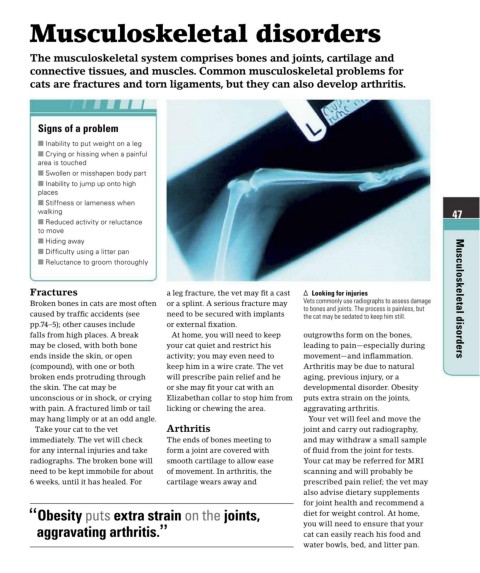
        Fractures                      a leg fracture, the vet may fit a cast    △  Looking for injuries
        Broken bones in cats are most often   or a splint. A serious fracture may   Vets commonly use radiographs to assess damage   Musculoskeletal disorders
        caused by traffic accidents (see   need to be secured with implants   to bones and joints. The process is painless, but
                                                                       the cat may be sedated to keep him still.
        pp.74–5); other causes include    or external fixation.
        falls from high places. A break    At home, you will need to keep   outgrowths form on the bones,
        may be closed, with both bone    your cat quiet and restrict his   leading to pain—especially during
        ends inside the skin, or open   activity; you may even need to    movement—and inflammation.
        (compound), with one or both   keep him in a wire crate. The vet   Arthritis may be due to natural
        broken ends protruding through   will prescribe pain relief and he    aging, previous injury, or a
        the skin. The cat may be       or she may fit your cat with an   developmental disorder. Obesity
        unconscious or in shock, or crying   Elizabethan collar to stop him from   puts extra strain on the joints,
        with pain. A fractured limb or tail   licking or chewing the area.  aggravating arthritis.
        may hang limply or at an odd angle.                             Your vet will feel and move the
         Take your cat to the vet      Arthritis                       joint and carry out radiography,
        immediately. The vet will check    The ends of bones meeting to    and may withdraw a small sample
        for any internal injuries and take   form a joint are covered with   of fluid from the joint for tests.
        radiographs. The broken bone will   smooth cartilage to allow ease    Your cat may be referred for MRI
        need to be kept immobile for about   of movement. In arthritis, the   scanning and will probably be
        6 weeks, until it has healed. For    cartilage wears away and   prescribed pain relief; the vet may
                                                                       also advise dietary supplements
                                                                       for joint health and recommend a
       “Obesity puts extra strain on the joints,                       diet for weight control. At home,
         aggravating arthritis.”                                       you will need to ensure that your
                                                                       cat can easily reach his food and
                                                                       water bowls, bed, and litter pan.


   US_046-047_Inherited_musculo_disorders.indd   47                                                  24/10/2013   14:56

