


Page 52 - Complete Cat Care: How To Keep Your Cat Healthy and Happy
P. 52
Coat and skin disorders


            Cats by nature keep their coat and skin healthy by grooming themselves.
            However, skin disorders can still affect them. Such problems are usually
            easy to spot, and will need prompt attention from a vet.

                                            Allergy                        The most common cause of allergic
                                            Allergic skin conditions can occur   skin disease and miliary dermatitis
              Signs of a problem            when your cat’s immune system,   is a hypersensitivity to fleas. Your
                                            which protects the body from   vet will check for infestation by
              ■ Dull, greasy coat           infection, overreacts to a certain   running a fine-toothed comb
              ■ Scaly, scabby, or crusty bits    substance, such as a type of food,   through your cat’s coat and may
              on skin and in coat           pollen, or parasite (see pp.52–3).   take skin scrapings for microscopic
              ■ Skin rash or spots          Signs could include many of those   examination. If your vet suspects
              ■ Hair loss                   listed in the box (left). In a reaction   that your cat’s allergy is caused
              ■ Color change                known as miliary dermatitis, the   by certain foods, he or she may
              ■ Itchiness with excessive licking   skin breaks out in little bumps,   advise a hypoallergenic diet for
     50       or scratching
              ■ Unpleasant smell from coat  scabs, and crusts, usually along the   a few weeks, and then gradually
              ■ “Hot cat” (cat whose skin feels   back and at the base of the tail.   reintroduce the original diet to try
                                                                           to identify triggers. Treatment of
                                            This condition often progresses to
              burning hot)
      Your cat’s health                     that need to be treated with an   as corticosteroid or cyclosporine, or
                                                                           allergies may include drugs such
                                            weeping areas of infected skin
              ■ Bumps or lumps
                                                                           a course of desensitizing vaccine.
                                            extended course of antibiotics.
                                                                           Antihistamines or omega-3 fatty
                                                                           acids may also be helpful.
                                                                           Ringworm
                                                                           This fungal infection is highly
                                                                           contagious and can be transmitted
                                                                           to or from humans as well as
                                                                           between animals. In cats it may
                                                                           cause gray, scaly, crusty areas on
                                                                           the skin and patches of fur loss,
                                                                           commonly on the head, ears, back,
                                                                           or paws. However, there may be no
                                                                           signs at all, and ringworm may not
                                                                           be diagnosed until a person in
                                                                           contact with the cat develops an
                                                                           itchy skin lesion (the infection
                                                                           rarely causes itching in cats).
                                                                             To make a diagnosis, the vet will
                                                                           examine the cat’s hair using an
                                                                           ultraviolet lamp (Wood’s lamp).
                                                                           Areas of hair infected by ringworm
                                                                           sometimes, but not always, glow
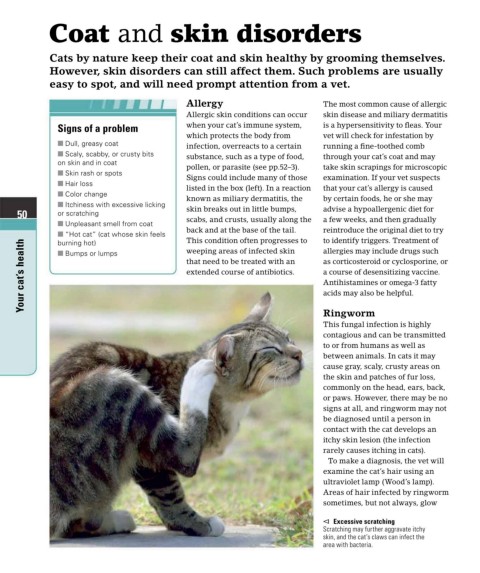
                                                                           ◁  Excessive scratching
                                                                           Scratching may further aggravate itchy
                                                                           skin, and the cat’s claws can infect the
                                                                           area with bacteria.


   US_050-051_Coat_and_skin_disorders.indd   50                                                      24/10/2013   14:55

