


Page 68 - Complete Cat Care: How To Keep Your Cat Healthy and Happy
P. 68
Reproductive disorders


            Most cats are neutered at about 4 months of age, so are unlikely to develop
            disorders of the reproductive system. However, “intact” toms (males) and
            queens (females) may develop problems with their reproductive organs.

                                            (release eggs from their ovaries)   Giving birth may cause the uterus
                                            until they mate. However, this   to be pushed outside the body.
              Signs of a problem            means that matings usually result   This is dangerous and needs
                                            in pregnancy. If a queen mates   immediate veterinary attention.
              ■ Distended abdomen (queen)   with several toms, the kittens    Another serious problem is
              ■ Thick, bloody, or foul-smelling   in her litter may have more than    infection of the uterus, causing a
              discharge from vulva          one father. Queens can naturally   buildup of pus. This may develop
              ■ Inflamed mammary glands     produce up to three litters per year.  a few days after giving birth or in
              ■ Lumps in mammary glands                                    the nonpregnant queen after a
              ■ Retained testes             Female problems                succession of seasons. Signs include

     66                                     Infertility in queens can occur if   fever, loss of appetite, and a bloody
                                            problems during mating prevent   or pus-filled vaginal discharge.
            Maturity and mating             ovulation from occurring. It    Nursing mothers may develop
                                                                           inflamed teats (mastitis) due
            Kittens usually reach puberty at
                                            may also be due to a hormone
      Your cat’s health  females can show signs of being    organism such as Toxoplasma    on the ovaries or tumors of the
                                                                           to overfilling or infection.
                                            imbalance, or an infectious
            around 6 months of age, although
                                                                             Older queens may develop cysts
                                            or possibly Chlamydophila felis.
            in season, or on heat, as young as
                                                                           ovaries, uterus, or mammary
                                            A vet may perform blood and
            4 months. Queens naturally start
                                            urine tests and scans to identify
                                                                           glands. A vet may use ultrasound
            coming into season with increasing
            day length in spring, but indoor
                                                                           these problems, and perform
            cats may have seasons all year   the underlying cause.         scans and take biopsies to identify
                                             Stress or infection may cause a
            round. Seasons may occur every    pregnant mother to abort her fetuses   surgery to remove the growths.
            3 weeks, but queens do not ovulate   or reabsorb them into her body.
                                                                           Male problems
                                                                           The problem of male infertility
                                                                           is rare, but one possible cause is
                                                                           retained testicles (cryptorchidism).
                                                                           In a male fetus the testes
                                                                           develop in the abdomen, and by
                                                                           the time the kitten is born they
                                                                           usually descend and hang under
                                                                           the tail in the scrotum. If both are
                                                                           retained in the abdomen beyond
                                                                           6 months of age, the tom will
                                                                           be sterile because his body
                                                                           temperature will be too high to
                                                                           allow sperm production. Injury,
                                                                           infections, or testicular cancer
                                                                           can also reduce male fertility.
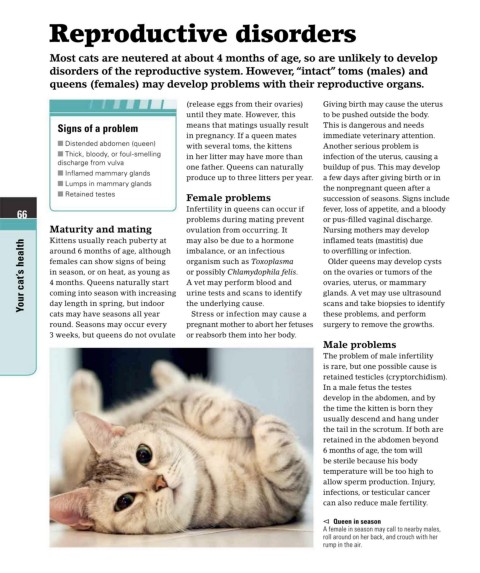
                                                                           ◁  Queen in season
                                                                           A female in season may call to nearby males,
                                                                           roll around on her back, and crouch with her
                                                                           rump in the air.


   US_066-067_Reproductive_Urinary_Disorders.indd   66                                               24/10/2013   15:05

