


Page 65 - Complete Cat Care: How To Keep Your Cat Healthy and Happy
P. 65
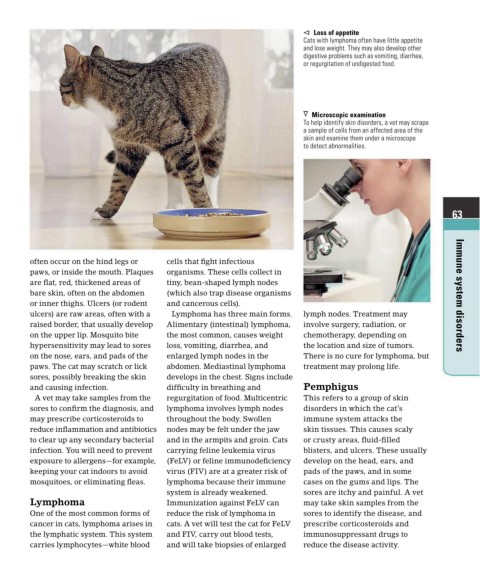
◁  Loss of appetite
                                                                       Cats with lymphoma often have little appetite
                                                                       and lose weight. They may also develop other
                                                                       digestive problems such as vomiting, diarrhea,
                                                                       or regurgitation of undigested food.


                                                                       ▽  Microscopic examination
                                                                       To help identify skin disorders, a vet may scrape
                                                                       a sample of cells from an affected area of the
                                                                       skin and examine them under a microscope
                                                                       to detect abnormalities.


                                                                                                         63


        often occur on the hind legs or   cells that fight infectious
        paws, or inside the mouth. Plaques   organisms. These cells collect in
        are flat, red, thickened areas of   tiny, bean-shaped lymph nodes
        bare skin, often on the abdomen    (which also trap disease organisms                             Immune system disorders
        or inner thighs. Ulcers (or rodent   and cancerous cells).
        ulcers) are raw areas, often with a   Lymphoma has three main forms.   lymph nodes. Treatment may
        raised border, that usually develop   Alimentary (intestinal) lymphoma,   involve surgery, radiation, or
        on the upper lip. Mosquito bite   the most common, causes weight   chemotherapy, depending on
        hypersensitivity may lead to sores   loss, vomiting, diarrhea, and   the location and size of tumors.
        on the nose, ears, and pads of the   enlarged lymph nodes in the   There is no cure for lymphoma, but
        paws. The cat may scratch or lick   abdomen. Mediastinal lymphoma   treatment may prolong life.
        sores, possibly breaking the skin   develops in the chest. Signs include
        and causing infection.         difficulty in breathing and     Pemphigus
         A vet may take samples from the   regurgitation of food. Multicentric   This refers to a group of skin
        sores to confirm the diagnosis, and   lymphoma involves lymph nodes   disorders in which the cat’s
        may prescribe corticosteroids to   throughout the body. Swollen   immune system attacks the
        reduce inflammation and antibiotics   nodes may be felt under the jaw   skin tissues. This causes scaly
        to clear up any secondary bacterial   and in the armpits and groin. Cats   or crusty areas, fluid-filled
        infection. You will need to prevent   carrying feline leukemia virus   blisters, and ulcers. These usually
        exposure to allergens—for example,   (FeLV) or feline immunodeficiency   develop on the head, ears, and
        keeping your cat indoors to avoid   virus (FIV) are at a greater risk of   pads of the paws, and in some
        mosquitoes, or eliminating fleas.   lymphoma because their immune   cases on the gums and lips. The
                                       system is already weakened.     sores are itchy and painful. A vet
        Lymphoma                       Immunization against FeLV can   may take skin samples from the
        One of the most common forms of   reduce the risk of lymphoma in    sores to identify the disease, and
        cancer in cats, lymphoma arises in   cats. A vet will test the cat for FeLV    prescribe corticosteroids and
        the lymphatic system. This system   and FIV, carry out blood tests,    immunosuppressant drugs to
        carries lymphocytes—white blood   and will take biopsies of enlarged   reduce the disease activity.


   US_062-063-Immune_disorders.indd   63                                                             24/10/2013   15:05

