


Page 63 - Complete Cat Care: How To Keep Your Cat Healthy and Happy
P. 63
Hormonal disorders


        Hormones are body chemicals that control particular functions. They are
        produced by glands and carried in the bloodstream to the places where they
        are needed. Any over- or underproduction of hormones may cause disorders.

                                       The cat may be ravenously hungry
                                       but still lose weight, and drink
          Signs of a problem           and urinate more than normal.
                                       Other signs include vomiting and
          ■ Excessive thirst (drinking from   diarrhea. You may be able to feel a
          unusual places such as puddles    rapid, thumping heartbeat. The fur
          or washing-up water)         may become dull and untidy. The
          ■ Increase or decrease in    cat may be restless and excitable,
          appetite—for example, a
          previously fussy cat eating   or in some cases lethargic. If
          anything and everything      untreated, hyperthyroidism may
          ■ Unusual weight gain or weight   lead to hypertension and heart
          loss, or inability to lose or gain   failure (see p.59).
          weight—may be subtle, developing   A vet may feel for an enlarged
          over a long time             thyroid in the neck, listen for
          ■ Change in coat (altered color,
          unusual texture, loss of fur—  a heart murmur (abnormal
          particularly on flanks and tail)  heart sound), measure the blood
                                       pressure, and take blood and urine
                                       samples. The vet may prescribe
                                       drugs or a low-iodine diet to
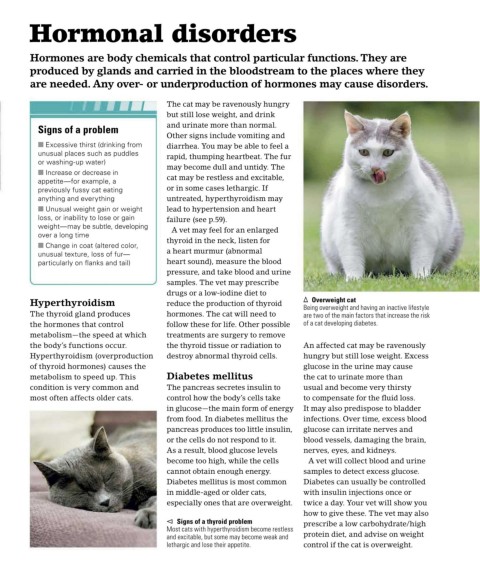
        Hyperthyroidism                reduce the production of thyroid   △  Overweight cat
                                                                       Being overweight and having an inactive lifestyle
        The thyroid gland produces     hormones. The cat will need to   are two of the main factors that increase the risk
        the hormones that control      follow these for life. Other possible   of a cat developing diabetes.
        metabolism—the speed at which   treatments are surgery to remove
        the body’s functions occur.    the thyroid tissue or radiation to   An affected cat may be ravenously
        Hyperthyroidism (overproduction   destroy abnormal thyroid cells.  hungry but still lose weight. Excess
        of thyroid hormones) causes the                                glucose in the urine may cause
        metabolism to speed up. This   Diabetes mellitus               the cat to urinate more than
        condition is very common and   The pancreas secretes insulin to   usual and become very thirsty
        most often affects older cats.   control how the body’s cells take    to compensate for the fluid loss.
                                       in glucose—the main form of energy   It may also predispose to bladder
                                       from food. In diabetes mellitus the   infections. Over time, excess blood
                                       pancreas produces too little insulin,   glucose can irritate nerves and
                                       or the cells do not respond to it.    blood vessels, damaging the brain,
                                       As a result, blood glucose levels   nerves, eyes, and kidneys.
                                       become too high, while the cells   A vet will collect blood and urine
                                       cannot obtain enough energy.    samples to detect excess glucose.
                                       Diabetes mellitus is most common   Diabetes can usually be controlled
                                       in middle-aged or older cats,   with insulin injections once or
                                       especially ones that are overweight.  twice a day. Your vet will show you
                                                                       how to give these. The vet may also
                                       ◁  Signs of a thyroid problem   prescribe a low carbohydrate/high
                                       Most cats with hyperthyroidism become restless
                                       and excitable, but some may become weak and   protein diet, and advise on weight
                                       lethargic and lose their appetite.  control if the cat is overweight.


   US_060-061_Nerv_horm_disorders.indd   61                                                          24/10/2013   15:05

