


Page 238 - (DK Eyewitness) Travel Guide - Rome
P. 238
236 ROME AREA B Y AREA
Exploring the Vatican’s Collections
The Vatican’s greatest treasures are its Greek and Roman Etruscan and Other
antiquities. These have been on display since the 18th century. Pre-Roman Art
The 19th century saw the addition of exciting discoveries from
Etruscan tombs and excavations in Egypt. In the Pinacoteca This collection comprises
artifacts from pre-Roman
(art gallery) there is a small, choice collection of paintings, civilizations in Etruria and Latium,
including works by Raphael, Titian, and Leonardo. Works by from Neolithic times to the 1st
great painters and sculptors are also on view throughout the century BC, when these ancient
older parts of the museums in the form of sumptuous populations were assimilated
decorations commissioned by the Renaissance popes. into the Roman state. Pride of
place in the Gregorian Etruscan
Museum goes to the objects
found in the Regolini-Galassi
tomb, excavated in 1836 at the
necropolis of Cerveteri (see p273).
The tomb was found intact and
yielded numerous everyday
household objects, plus a throne,
a bed, and a funeral cart, all cast
in bronze, dating from the
7th century BC. Beautiful black
vases, delightful terracotta
figurines, and bronze statues
such as the famous Mars of Todi,
displayed in the Room of the
Bronzes, show the Etruscans
to have been a highly civilized,
sophisticated people.
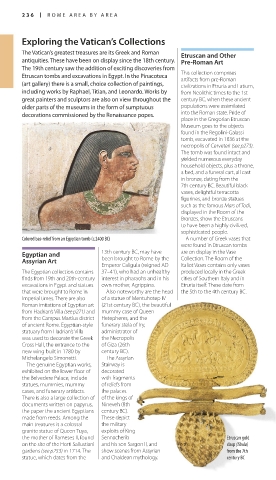
Colored bas-relief from an Egyptian tomb (c.2400 BC) A number of Greek vases that
were found in Etruscan tombs
Egyptian and 13th century BC, may have are on display in the Vase
Assyrian Art been brought to Rome by the Collection. The Room of the
Emperor Caligula (reigned AD Italiot Vases contains only vases
The Egyptian collection contains 37–41), who had an unhealthy produced locally in the Greek
finds from 19th and 20th-century interest in pharaohs and in his cities of Southern Italy and in
excavations in Egypt and statues own mother, Agrippina. Etruria itself. These date from
that were brought to Rome in Also noteworthy are the head the 5th to the 4th century BC.
Imperial times. There are also of a statue of Mentuhotep IV
Roman imitations of Egyptian art (21st century BC), the beautiful
from Hadrian’s Villa (see p271) and mummy case of Queen
from the Campus Martius district Hetepheres, and the
of ancient Rome. Egyptian-style funerary stela of Iry,
statuary from Hadrian’s Villa administrator of
was used to decorate the Greek the Necropolis
Cross Hall, the entrance to the of Giza (26th
new wing built in 1780 by century BC).
Michelangelo Simonetti. The Assyrian
The genuine Egyptian works, Stairway is
exhibited on the lower floor of decorated
the Belvedere Palace, include with fragments
statues, mummies, mummy of reliefs from
cases, and funerary artifacts. the palaces
There is also a large collection of of the kings of
documents written on papyrus, Nineveh (8th
the paper the ancient Egyptians century BC).
made from reeds. Among the These depict
main treasures is a colossal the military
granite statue of Queen Tuya, exploits of King
the mother of Rameses II, found Sennacherib Etruscan gold
on the site of the Horti Sallustiani and his son Sargon II, and clasp (fibula)
gardens (see p253) in 1714. The show scenes from Assyrian from the 7th
statue, which dates from the and Chaldean mythology. century BC
US_236-237_EW_Rome_US.indd 236 15/03/17 3:53 pm
Eyewitness Travel LAYERS PRINTED:
Flashmap follow-on template “UK” LAYER
(Source v1.3)
Date 18th October 2012
Size 125mm x 217mm

