


Page 239 - (DK Eyewitness) Travel Guide - Rome
P. 239
V A TIC AN 237
The much smaller Chiaramonti dependence upon Greek
Museum, named after Pope models to a recognizably
Pius VII Chiaramonti, was laid Roman style. Original Greek
out by Canova in the early works include large marble
19th century. It includes a fragments from the Parthenon
striking colossal head of the in Athens. There is also a
goddess Athena. The Braccio Roman copy of Athena and
Nuovo, an extension of the Marsyas by Myron, which was
Chiaramonti, decorated with part of the decoration of the
Roman floor mosaics, contains Parthenon. Totally Roman in
a statue of Augustus from the character are two reliefs known
villa of his wife Livia at Prima as the Rilievi della Cancelleria,
Porta. Its pose is based on the because they were discovered
famous Doryphoros by the beneath the Palazzo della
Greek sculptor Polyclitus, of Cancelleria (see p151) in the
which there is a Roman copy 1930s. They show military
on display opposite. parades of the Emperor
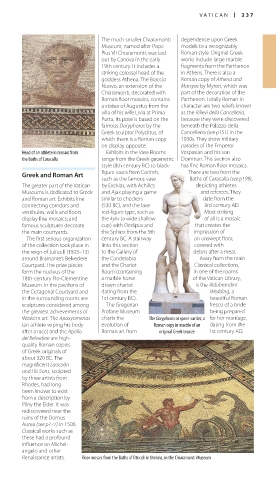
Head of an athlete in mosaic from Exhibits in the Vase Rooms Vespasian and his son
the Baths of Caracalla range from the Greek geometric Domitian. This section also
style (8th century BC) to black- has fine Roman floor mosaics.
Greek and Roman Art figure vases from Corinth, There are two from the
such as the famous vase Baths of Caracalla (see p199),
The greater part of the Vatican by Exekias, with Achilles depicting athletes
Museums is dedicated to Greek and Ajax playing a game and referees. They
and Roman art. Exhibits line similar to checkers date from the
connecting corridors and (530 BC), and the later 3rd century AD.
vestibules; walls and floors red-figure type, such as Most striking
display fine mosaics; and the kylix (a wide shallow of all is a mosaic
famous sculptures decorate cup) with Oedipus and that creates the
the main courtyards. the Sphinx from the 5th impression of
The first serious organization century BC. A stair way an unswept floor,
of the collection took place in links this section covered with
the reign of Julius II (1503–13) to the Gallery of debris after a meal.
around Bramante’s Belvedere the Cande labra Away from the main
Courtyard. The prize pieces and the Chariot Classical collections,
form the nucleus of the Room (containing in one of the rooms
18th-century Pio-Clementine a marble horse- of the Vatican Library,
Museum. In the pavilions of drawn chariot is the Aldobrandini
the Octagonal Courtyard and dating from the Wedding, a
in the surrounding rooms are 1st century BC). beautiful Roman
sculptures considered among The Gregorian fresco of a bride
the greatest achievements of Profane Museum being prepared
Western art. The Apoxyomenos charts the The Doryphoros or spear-carrier, a for her marriage,
(an athlete wiping his body evolution of Roman copy in marble of an dating from the
after a race) and the Apollo Roman art from original Greek bronze 1st century AD.
del Belvedere are high-
quality Roman copies
of Greek originals of
about 320 BC. The
magnificent Laocoön
and His Sons, sculpted
by three artists from
Rhodes, had long
been known to exist
from a description by
Pliny the Elder. It was
rediscov ered near the
ruins of the Domus
Aurea (see p177) in 1506.
Classical works such as
these had a profound
influence on Michel-
angelo and other
Renaissance artists. Floor mosaic from the Baths of Otricoli in Umbria, in the Chiaramonti Museum
US_236-237_EW_Rome_US.indd 237 15/03/17 3:53 pm

