


Page 19 - All About History - Issue 56-17
P. 19
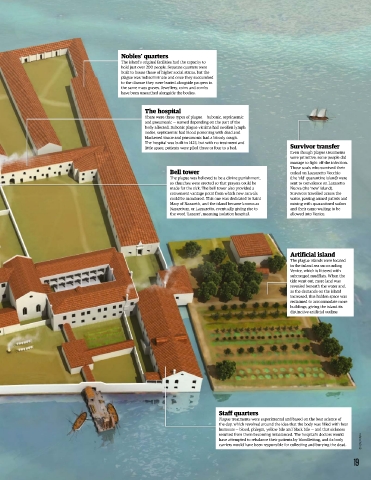
Nobles’  quarters
                                            The island’s original facilities had the capacity to
                                            hold just over 200 people. Separate quarters were
                                            built to house those of higher social status, but the
                                            plague was indiscriminate and once they succumbed
                                            to the disease they were buried alongside paupers in
                                            the same mass graves. Jewellery, coins and combs
                                            have been unearthed alongside the bodies.


                                                    The  hospital
                                                    There were three types of plague — bubonic, septicaemic
                                                    and pneumonic — named depending on the part of the
                                                    body affected. Bubonic plague victims had swollen lymph
                                                    nodes, septicaemic had blood poisoning with dead and
                                                    blackened tissue and pneumonic had a bloody cough.
                                                    The hospital was built in 1423, but with no treatment and
                                                    little space, patients were piled three or four to a bed.   Survivor transfer
                                                                                                       Even though plague treatments
                                                                                                       were primitive, some people did
                                                                                                       manage to fight off the infection.
                                                                                                       Those souls who survived their
                                                             Bell  tower                               ordeal on Lazzaretto Vecchio
                                                             The plague was believed to be a divine punishment,   (the ‘old’ quarantine island) were
                                                             so churches were erected so that prayers could be   sent to convalesce on Lazaretto
                                                             made for the sick. The bell tower also provided a   Nuova (the ‘new’ island).
                                                             convenient vantage point from which new arrivals   Survivors travelled across the
                                                             could be monitored. This one was dedicated to Saint   water, passing armed patrols and
                                                             Mary of Nazareth, and the island became known as   mixing with quarantined sailors
                                                             Nazaretum, or Lazzaretto, eventually giving rise to   and their cargo waiting to be
                                                             the word ‘Lazaret’, meaning isolation hospital.   allowed into Venice.


                                                                                                       Artificial island
                                                                                                       The plague islands were located
                                                                                                       in the inland sea surrounding
                                                                                                       Venice, which is littered with
                                                                                                       submerged mudflats. When the
                                                                                                       tide went out, more land was
                                                                                                       revealed beneath the water and,
                                                                                                       as the demands on the island
                                                                                                       increased, this hidden space was
                                                                                                       reclaimed to accommodate more
                                                                                                       buildings, giving the island its
                                                                                                       distinctive artificial outline.


                                                                              Staff quarters
                                                                              Plague treatments were experimental and based on the best science of
                                                                              the day, which revolved around the idea that the body was filled with four
                                                                              humours — blood, phlegm, yellow bile and black bile — and that sickness
                                                                              resulted from them becoming imbalanced. The hospital’s doctors would
                                                                              have attempted to rebalance their patients by bloodletting, and its body   © Adrian Mann
                                                                              carriers would have been responsible for collecting and burying the dead.

                                                                                                                             19

