


Page 18 - All About History - Issue 56-17
P. 18
EpidEmics


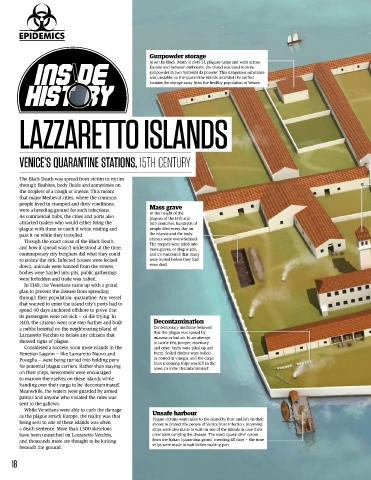
                                                      Gunpowder   storage
                                                      After the Black Death of 1346-53, plagues came and went across
                                                      Europe and between outbreaks, the island was used to store
                                                      gunpowder in two ‘torresini da polvere’. This dangerous substance
                                                      was unstable, so the quarantine islands provided the perfect
                                                      location for storage away from the healthy population of Venice.


        LAZZARETTO ISLANDS


        VENICE’S QUARANTINE STATIONS, 15TH CENTURY


        The Black Death was spread from victim to victim
        through fleabites, body fluids and sometimes on
        the droplets of a cough or sneeze. This meant
        that major Medieval cities, where the common
        people lived in cramped and dirty conditions,
        were a breeding ground for such infections.   Mass  grave
                                                      At the height of the
        As commercial hubs, the cities and ports also
                                                      plagues of the 14th and
        attracted traders who would either bring the   16th centuries, hundreds of
        plague with them or catch it while visiting and   people died every day on
        pass it on while they travelled.              the islands and the body
                                                      carriers were overwhelmed.
          Though the exact cause of the Black Death
                                                      The corpses were piled into
        and how it spread wasn’t understood at the time,   mass graves, or plague pits,
        contemporary city burghers did what they could   and it’s rumoured that many
        to isolate the sick. Infected houses were locked   were buried before they had
                                                      even died.
        down, animals were banned from the streets,
        bodies were hauled into pits, public gatherings
        were forbidden and trade was halted.
          In 1348, the Venetians came up with a grand
        plan to prevent the disease from spreading
        through their population: quarantine. Any vessel
        that wanted to enter the island city’s ports had to
        spend 40 days anchored offshore to prove that
        its passengers were not sick — or die trying. In
        1403, the citizens went one step further and built   Decontamination
        a public hospital on the neighbouring island of   Contemporary medicine believed
                                                       that the plague was spread by
        Lazzaretto Vecchio to isolate any citizens that
                                                       miasma or bad air. In an attempt
        showed signs of plague.                        to tackle this, juniper, rosemary
          Considered a success, soon more islands in the   and other herbs were piled up and
        Venetian Lagoon — like Lazzaretto Nuovo and    burnt. Soiled clothes were boiled
                                                       or coated in vinegar, and the cargo
        Poveglia — were being turned into holding pens
                                                       from incoming ships was left in the
        for potential plague carriers. Rather than staying
                                                       open air to be ‘decontaminated’.
        on their ships, newcomers were encouraged
        to maroon themselves on these islands while
        handing over their cargo to be ‘decontaminated’.
        Meanwhile, the waters were guarded by armed
        patrols and anyone who violated the rules was
        sent to the gallows.
          While Venetians were able to curb the damage   Unsafe harbour
        as the plague struck Europe, the reality was that
                                                       Plague victims were taken to the island by boat and left on their
        being sent to one of these islands was often    shores to protect the people of Venice from infection. Incoming
        a death sentence. More than 1,500 skeletons    ships were also made to wait on one of the islands in case their
        have been unearthed on Lazzaretto Vecchio,     crew were carrying the disease. The word ‘quarantine’ comes
        and thousands more are thought to be lurking    from the Italian ‘quarantina giorni’, meaning 40 days — the time
                                                       ships were made to wait before making port.
        beneath the ground.

     18

