


Page 237 - Inventions - A Visual Encyclopedia (DK - Smithsonian)
P. 237
Louis Pasteur in his laboratory
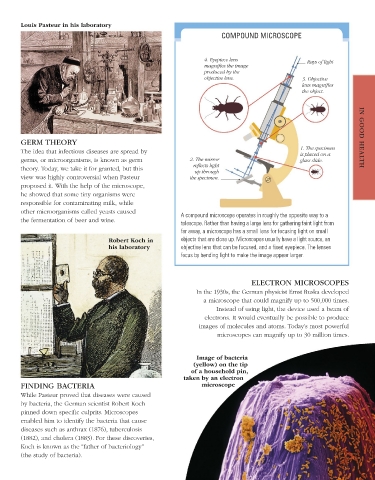
                                                                         COMPOUND MICROSCOPE


                                                                    4. Eyepiece lens                 Rays of light
                                                                    magnifies the image
                                                                    produced by the
                                                                    objective lens.                 3. Objective
                                                                                                    lens magnifies
                                                                                                    the object.


        GERM THEORY                                                                                                    IN GOOD HEALTH
                                                                                                   1. The specimen
        The idea that infectious diseases are spread by
                                                                                                   is placed on a
        germs, or microorganisms, is known as germ             2. The mirror                       glass slide.
                                                                reflects light
        theory. Today, we take it for granted, but this
                                                                 up through
        view was highly controversial when Pasteur             the specimen.
        proposed it. With the help of the microscope,
        he showed that some tiny organisms were
        responsible for contaminating milk, while
        other microorganisms called yeasts caused           A compound microscope operates in roughly the opposite way to a
        the fermentation of beer and wine.                  telescope. Rather than having a large lens for gathering faint light from
                                                            far away, a microscope has a small lens for focusing light on small
                                    Robert Koch in          objects that are close up. Microscopes usually have a light source, an
                                    his laboratory          objective lens that can be focused, and a fixed eyepiece. The lenses
                                                            focus by bending light to make the image appear larger.


                                                                                   ELECTRON MICROSCOPES
                                                                 In the 1930s, the German physicist Ernst Ruska developed
                                                                   a microscope that could magnify up to 500,000 times.
                                                                        Instead of using light, the device used a beam of
                                                                    electrons. It would eventually be possible to produce
                                                                  images of molecules and atoms. Today’s most powerful
                                                                        microscopes can magnify up to 30 million times.


                                                                 Image of bacteria
                                                                (yellow) on the tip
                                                               of a household pin,
                                                             taken by an electron
        FINDING BACTERIA                                           microscope
        While Pasteur proved that diseases were caused
        by bacteria, the German scientist Robert Koch
        pinned down specific culprits. Microscopes
        enabled him to identify the bacteria that cause
        diseases such as anthrax (1876), tuberculosis
        (1882), and cholera (1883). For these discoveries,
        Koch is known as the “father of bacteriology”
        (the study of bacteria).
                                                                                                                235


   US_234-235_Microscopes_Main.indd   235                                                                        12/04/18   1:30 PM

