


Page 232 - Inventions - A Visual Encyclopedia (DK - Smithsonian)
P. 232
Anesthetics


          Before the mid-19th century, surgery was very painful
          because it had to be carried out without effective

          painkillers. In the 1840s, the use of anesthetics—
          medicines that cause temporary loss of sensation—

          began to become widespread. Today, a wide range
      IN GOOD HEALTH  of anesthetics has made surgery largely pain free.


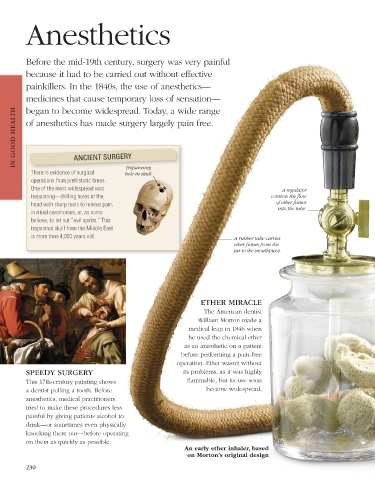
                         ANCIENT SURGERY

                                          Trepanning
           There is evidence of surgical   hole in skull
           operations from prehistoric times.
           One of the most widespread was                                                    A regulator
           trepanning—drilling holes in the                                              controls the flow
           head with sharp tools to relieve pain,                                          of ether fumes
           in ritual ceremonies, or, as some                                                into the tube.
           believe, to let out “evil spirits.” This
           trepanned skull from the Middle East
           is more than 4,000 years old.                                     A rubber tube carries
                                                                             ether fumes from the
                                                                             jar to the mouthpiece.


                                                                   ETHER MIRACLE
                                                                    The American dentist
                                                                  William Morton made a
                                                               medical leap in 1846 when
                                                               he used the chemical ether
                                                             as an anesthetic on a patient
                                                            before performing a pain-free
                                                           operation. Ether wasn’t without
          SPEEDY SURGERY                                     its problems, as it was highly
          This 17th-century painting shows                    flammable, but its use soon
          a dentist pulling a tooth. Before                         became widespread.
          anesthetics, medical practitioners
          tried to make these procedures less
          painful by giving patients alcohol to
          drink—or sometimes even physically
          knocking them out—before operating
          on them as quickly as possible.
                                                             An early ether inhaler, based
                                                              on Morton’s original design
          230


   US_230-231_Anaesthetics_Main.indd   230                                                                       08/03/18   3:10 PM

