


Page 238 - Inventions - A Visual Encyclopedia (DK - Smithsonian)
P. 238
War on germs


          In the early 1800s, many patients died in hospitals
          from infections picked up during surgery or childbirth.

          By the middle of the century, scientists had begun
          to understand that infections were caused by invisible                          HOSPITAL HYGIENE

          germs. They campaigned to improve the cleanliness
      IN GOOD HEALTH  of hospitals, but faced opposition from doctors who           Nowadays, hospital staff carefully


          refused to accept the new theories.
                                                                                    scrub their hands before any contact
                                                                                    with patients. The practice was
                                                                                    pioneered by the Hungarian doctor Ignaz

                                                                                    Vienna, Austria. He discovered that if
          THE FIRST ANTISEPTIC                                                      Semmelweis in 1847 at a hospital in
                                                                                    doctors washed their hands in mildly
          In the 1860s, the British surgeon Joseph Lister took the first            chlorinated water before surgery, the
          practical steps to prevent airborne infections during surgery.            death rate of patients dropped.
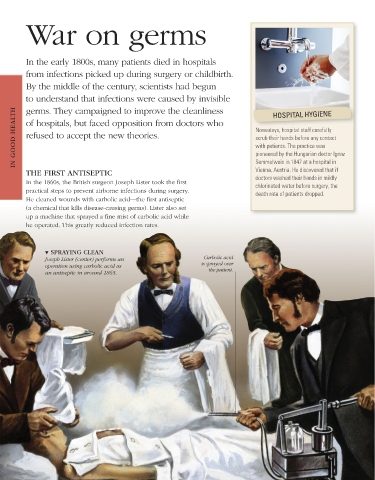
          He cleaned wounds with carbolic acid—the first antiseptic
          (a chemical that kills disease-causing germs). Lister also set
          up a machine that sprayed a fine mist of carbolic acid while
          he operated. This greatly reduced infection rates.


                ▼ SPRAYING CLEAN
                Joseph Lister (center) performs an                  Carbolic acid
                operation using carbolic acid as                   is sprayed over
                an antiseptic in around 1865.                        the patient.


   US_236-237_War_on_germs_Main.indd   236                                                                       08/03/18   3:10 PM

