


Page 236 - Inventions - A Visual Encyclopedia (DK - Smithsonian)
P. 236
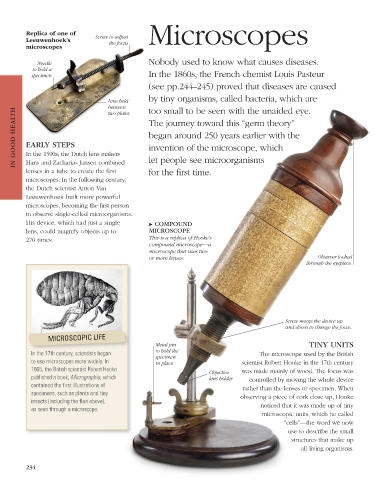
Replica of one of                       Microscopes
          Leeuwenhoek’s         Screw to adjust
          microscopes                the focus

             Needle                               Nobody used to know what causes diseases.
            to hold a
           specimen                               In the 1860s, the French chemist Louis Pasteur
                                                  (see pp.244–245) proved that diseases are caused
                                                  by tiny organisms, called bacteria, which are
                                    Lens held
                                    between       too small to be seen with the unaided eye.
      IN GOOD HEALTH  EARLY STEPS                 The journey toward this “germ theory”
                                    two plates


                                                  began around 250 years earlier with the
                                                  invention of the microscope, which
          In the 1590s, the Dutch lens makers
          Hans and Zacharias Jansen combined
                                                  for the first time.
          lenses in a tube to create the first    let people see microorganisms
          microscopes. In the following century,
          the Dutch scientist Anton Van
          Leeuwenhoek built more powerful
          microscopes, becoming the first person
          to observe single-celled microorganisms.
          His device, which had just a single     ▶ COMPOUND
          lens, could magnify objects up to       MICROSCOPE
          270 times.                              This is a replica of Hooke’s
                                                  compound microscope—a
                                                  microscope that uses two
                                                  or more lenses.                                        Observer looked
                                                                                                     through the eyepiece.


                                                                                              Screw moves the device up
                                                                                              and down to change the focus.
                 MICROSCOPIC LIFE
                                                    Metal pin                                         TINY UNITS
           In the 17th century, scientists began    to hold the                       The microscope used by the British
           to use microscopes more widely. In       specimen                    scientist Robert Hooke in the 17th century
                                                    in place
           1665, the British scientist Robert Hooke                  Objective   was made mainly of wood. The focus was
           published a book, Micrographia, which                     lens holder  controlled by moving the whole device
           contained the first illustrations of                                 rather than the lenses or specimen. When
           specimens, such as plants and tiny                                   observing a piece of cork close up, Hooke
           insects (including the flea above),
           as seen through a microscope.                                              noticed that it was made up of tiny
                                                                                       microscopic units, which he called
                                                                                              “cells”—the word we now
                                                                                               use to describe the small
                                                                                                structures that make up
                                                                                                   all living organisms.

          234


   US_234-235_Microscopes_Main.indd   234                                                                        12/04/18   1:30 PM

