


Page 263 - Inventions - A Visual Encyclopedia (DK - Smithsonian)
P. 263
POWERING SATELLITES
                Early satellites relied on
          batteries that drained rapidly in
          the cold of space, giving them
             a limited lifetime. The US’s
            second satellite, Vanguard 1,
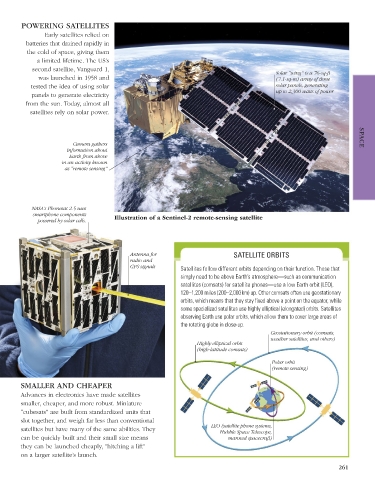
                                                                                           Solar “wing” is a 76-sq-ft
              was launched in 1958 and                                                     (7.1-sq-m) array of three
           tested the idea of using solar                                                  solar panels, generating
                                                                                           up to 2,300 watts of power
           panels to generate electricity
         from the sun. Today, almost all
           satellites rely on solar power.


                         Camera gathers                                                                                SPACE
                       information about
                        Earth from above
                     in an activity known
                      as “remote sensing”


           NASA’s Phonesat 2.5 uses
            smartphone components     Illustration of a Sentinel-2 remote-sensing satellite
             powered by solar cells.


                                           Antenna for                       SATELLITE ORBITS
                                           radio and
                                           GPS signals      Satellites follow different orbits depending on their function. Those that
                                                            simply need to be above Earth’s atmosphere—such as communication
                                                            satellites (comsats) for satellite phones—use a low Earth orbit (LEO),
                                                            120–1,200 miles (200–2,000 km) up. Other comsats often use geostationary
                                                            orbits, which means that they stay fixed above a point on the equator, while
                                                            some specialized satellites use highly elliptical (elongated) orbits. Satellites
                                                            observing Earth use polar orbits, which allow them to cover large areas of
                                                            the rotating globe in close-up.
                                                                                         Geostationary orbit (comsats,
                                                                                         weather satellites, and others)
                                                                 Highly elliptical orbit
                                                                 (high-latitude comsats)
                                                                                          Polar orbit
                                                                                          (remote sensing)


        SMALLER AND CHEAPER
        Advances in electronics have made satellites
        smaller, cheaper, and more robust. Miniature
        “cubesats” are built from standardized units that
        slot together, and weigh far less than conventional
                                                                      LEO (satellite phone systems,
        satellites but have many of the same abilities. They
                                                                         Hubble Space Telescope,
        can be quickly built and their small size means                    manned spacecraft)
        they can be launched cheaply, “hitching a lift”
        on a larger satellite’s launch.
                                                                                                                261


   US_260-261_Satellites_Main.indd   261                                                                         08/03/18   3:10 PM

