


Page 264 - Inventions - A Visual Encyclopedia (DK - Smithsonian)
P. 264
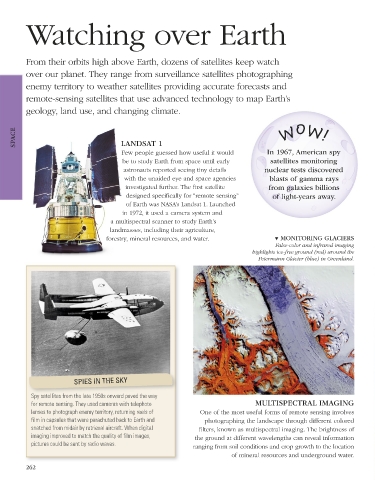
Watching over Earth


          From their orbits high above Earth, dozens of satellites keep watch
          over our planet. They range from surveillance satellites photographing

          enemy territory to weather satellites providing accurate forecasts and
          remote-sensing satellites that use advanced technology to map Earth’s

          geology, land use, and changing climate.


      SPACE                              LANDSAT 1                                           WOW!


                                         Few people guessed how useful it would         In 1967, American spy
                                         be to study Earth from space until early        satellites monitoring
                                         astronauts reported seeing tiny details       nuclear tests discovered
                                          with the unaided eye and space agencies        blasts of gamma rays
                                          investigated further. The first satellite      from galaxies billions
                                          designed specifically for “remote sensing”      of light-years away.
                                          of Earth was NASA’s Landsat 1. Launched
                                         in 1972, it used a camera system and
                                     a multispectral scanner to study Earth’s
                                     landmasses, including their agriculture,
                                    forestry, mineral resources, and water.                ▼ MONITORING GLACIERS
                                                                                           False-color and infrared imaging
                                                                                   highlights ice-free ground (red) around the
                                                                                     Petermann Glacier (blue) in Greenland.


                         SPIES IN THE SKY


           Spy satellites from the late 1950s onward paved the way
           for remote sensing. They used cameras with telephoto                     MULTISPECTRAL IMAGING
           lenses to photograph enemy territory, returning reels of    One of the most useful forms of remote sensing involves
           film in capsules that were parachuted back to Earth and   photographing the landscape through different colored
           snatched from midair by retrieval aircraft. When digital   filters, known as multispectral imaging. The brightness of
           imaging improved to match the quality of film images,    the ground at different wavelengths can reveal information
           pictures could be sent by radio waves.               ranging from soil conditions and crop growth to the location
                                                                             of mineral resources and underground water.
          262


   US_262-263_Remote_sensing_Main.indd   262                                                                     08/03/18   3:10 PM

