


Page 265 - Inventions - A Visual Encyclopedia (DK - Smithsonian)
P. 265
WEATHER WATCHERS
         The first weather satellite, TIROS-1, was launched
         in 1960, and by the 1970s, satellites were placed
             in high orbits where they could photograph
             weather patterns across large areas of Earth.
          Today, remote-sensing instruments can monitor
        wind speeds, temperature, and other conditions in
        the atmosphere and oceans, measuring large-scale
          patterns and changes to Earth’s overall climate.
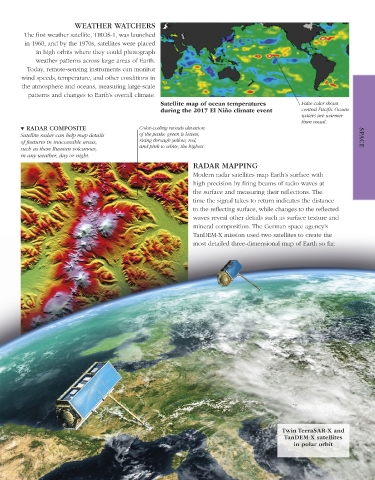
                                                     Satellite map of ocean temperatures           False color shows
                                                     during the 2017 El Niño climate event         central Pacific Ocean
                                                                                                   waters are warmer
                                                                                                   than usual.
        ▼ RADAR COMPOSITE                     Color-coding reveals elevation
        Satellite radar can help map details   of the peaks: green is lowest,                                          SPACE
        of features in inaccessible areas,    rising through yellow, red,
        such as these Russian volcanoes,      and pink to white, the highest.
        in any weather, day or night.
                                                                RADAR MAPPING
                                                                Modern radar satellites map Earth’s surface with
                                                                high precision by firing beams of radio waves at
                                                                the surface and measuring their reflections. The
                                                                time the signal takes to return indicates the distance
                                                                to the reflecting surface, while changes to the reflected
                                                                waves reveal other details such as surface texture and
                                                                mineral composition. The German space agency’s
                                                                TanDEM-X mission used two satellites to create the
                                                                most detailed three-dimensional map of Earth so far.


                                                                                             Twin TerraSAR-X and
                                                                                              TanDEM-X satellites
                                                                                                 in polar orbit


   US_262-263_Remote_sensing_Main.indd   263                                                                     16/03/18   3:41 PM

