


Page 267 - Inventions - A Visual Encyclopedia (DK - Smithsonian)
P. 267
HOW GPS WORKS

                                                             The Global Positioning System (GPS) and similar navigation systems
                                                             rely on networks of satellites in precisely known orbits. Each satellite
                                                             carries a super-accurate atomic clock and transmits a time signal
                                                             continuously. A computerized receiver measures how long it takes
                                                             signals from different satellites to arrive, and uses that information
                                                             to calculate the distance between itself and each of the satellites.
                                                             Together, the measurements pinpoint the receiver’s exact location.


                                                               Satellite in
                                                              precise orbit              Signals take different
        SYNCOM                                                  sends out                times to reach receiver.
                                                              time signal.
        Science-fiction author Arthur C. Clarke realized in                                                            SPACE
        1945 that satellites in high “geostationary” orbits
        would be able to relay global communication
        signals. They would hang in a fixed position over
        the equator, so antennae could bounce signals                                                At least four
                                                                 Receiver
        over a large area via a satellite without having to                                        visible satellites
                                                                calculates                        are required for
        track it. The first satellite to put Clarke’s idea into   distance to                     an accurate fix.
        practice was Syncom 3, which relayed live television   each satellite.
        coverage of the 1964 Tokyo Olympics.


                            CALLS TO ORBIT                                                        External antenna
              Most international telephone calls travel under the sea in                          boosts signal
            fiber-optic cables, avoiding the time delays introduced when
            relaying signals over a long distance through ground stations
             via comsats in high orbit. But what if you are in a remote
             location with no link to a cell or landline network? Satellite
             telephones send signals directly to a satellite in low orbit,
           enabling communication from almost everywhere. They were
                originally designed for ships at sea, by the Inmarsat
                           organization in the 1980s.


                 WOW!

                GPS navigation
            receivers can pinpoint
            your location to within
             16 ft (5 m)—Europe’s
            Galileo system can do
                it to the nearest
                  centimeter!


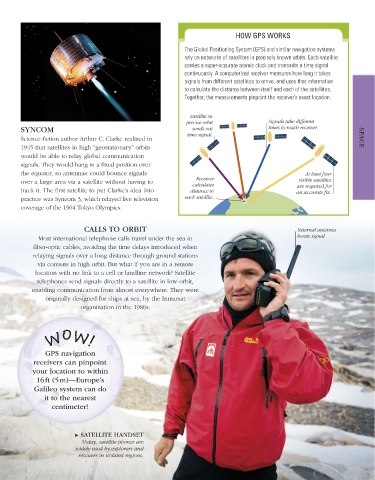
                         ▶ SATELLITE HANDSET
                            Today, satellite phones are
                          widely used by explorers and
                           rescuers in isolated regions.


   US_264-265_Communication_Main.indd   265                                                                      16/03/18   3:41 PM

