


Page 279 - Inventions - A Visual Encyclopedia (DK - Smithsonian)
P. 279
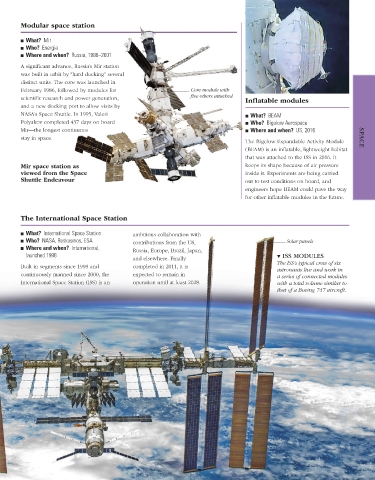
Modular space station


        ■ ■ What?  Mir
        ■ ■ Who?  Energia
        ■ ■ Where and when?  Russia, 1986–2001
        A significant advance, Russia’s Mir station
        was built in orbit by “hard docking” several
        distinct units. The core was launched in
        February 1986, followed by modules for                 Core module with
        scientific research and power generation,              five others attached  Inflatable modules
        and a new docking port to allow visits by
        NASA’s Space Shuttle. In 1995, Valeri                                    ■ ■ What?  BEAM
        Polyakov completed 437 days on board                                     ■ ■ Who?  Bigelow Aerospace
        Mir—the longest continuous                                               ■ ■ Where and when?  US, 2016
        stay in space.                                                                                                 SPACE
                                                                                 The Bigelow Expandable Activity Module
                                                                                 (BEAM) is an inflatable, lightweight habitat
                                                                                 that was attached to the ISS in 2016. It
        Mir space station as                                                     keeps its shape because of air pressure
        viewed from the Space                                                    inside it. Experiments are being carried
        Shuttle Endeavour                                                        out to test conditions on board, and
                                                                                 engineers hope BEAM could pave the way
                                                                                 for other inflatable modules in the future.


        The International Space Station

        ■ ■ What?  International Space Station  ambitious collaboration with
        ■ ■ Who?  NASA, Roskosmos, ESA      contributions from the US,                         Solar panels
        ■ ■ Where and when?  International,    Russia, Europe, Brazil, Japan,
          launched 1998                                                                    ▼ ISS MODULES
                                            and elsewhere. Finally
                                                                                           The ISS’s typical crew of six
        Built in segments since 1998 and    completed in 2011, it is
                                                                                           astronauts live and work in
        continuously manned since 2000, the   expected to remain in                        a series of connected modules
        International Space Station (ISS) is an   operation until at least 2028.           with a total volume similar to
                                                                                           that of a Boeing 747 aircraft.


   US_276-277_Space_Station_Main.indd   277                                                                      09/03/18   4:10 PM

