


Page 278 - Inventions - A Visual Encyclopedia (DK - Smithsonian)
P. 278
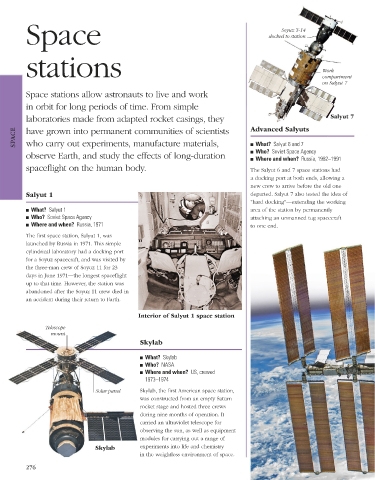
Space                                                                          docked to station
                                                                                             Soyuz T-14


          stations                                                                                        Work


                                                                                                          compartment
                                                                                                          on Salyut 7
          Space stations allow astronauts to live and work

          in orbit for long periods of time. From simple
          laboratories made from adapted rocket casings, they                                                Salyut 7

      SPACE  have grown into permanent communities of scientists                   Advanced Salyuts
          who carry out experiments, manufacture materials,
                                                                                    ■ What?  Salyut 6 and 7
                                                                                   ■
          observe Earth, and study the effects of long-duration                    ■ ■ Who?  Soviet Space Agency
                                                                                   ■ ■ Where and when?  Russia, 1982–1991
          spaceflight on the human body.                                           The Salyut 6 and 7 space stations had

                                                                                   a docking port at both ends, allowing a
                                                                                   new crew to arrive before the old one
          Salyut 1                                                                 departed. Salyut 7 also tested the idea of
                                                                                   “hard docking”—extending the working
          ■ ■ What?  Salyut 1                                                      area of the station by permanently
          ■ ■ Who?  Soviet Space Agency                                            attaching an unmanned tug spacecraft
          ■ ■ Where and when?  Russia, 1971                                        to one end.
          The first space station, Salyut 1, was
          launched by Russia in 1971. This simple
          cylindrical laboratory had a docking port
          for a Soyuz spacecraft, and was visited by
          the three-man crew of Soyuz 11 for 23
          days in June 1971—the longest spaceflight
          up to that time. However, the station was
          abandoned after the Soyuz 11 crew died in
          an accident during their return to Earth.


                                              Interior of Salyut 1 space station
                Telescope
                  mount
                                               Skylab

                                               ■ ■ What?  Skylab
                                               ■ ■ Who?  NASA
                                               ■ ■ Where and when?  US, crewed
                                                 1973–1974
                                Solar panel    Skylab, the first American space station,
                                               was constructed from an empty Saturn
                                               rocket stage and hosted three crews
                                               during nine months of operation. It
                                               carried an ultraviolet telescope for
                                               observing the sun, as well as equipment
                                               modules for carrying out a range of
                                Skylab         experiments into life and chemistry
                                               in the weightless environment of space.
          276


   US_276-277_Space_Station_Main.indd   276                                                                      16/03/18   3:41 PM

