


Page 276 - Inventions - A Visual Encyclopedia (DK - Smithsonian)
P. 276
Manned missions


          In the course of six decades, the idea of human spaceflight
          has gone from the unthinkable to the almost routine                                WOW!

          (though still inevitably risky). So far more than 550 people
                                                                                        In 1961, when President
          have flown into space, the vast majority of them aboard                     Kennedy committed the US

          either the United States’ Space Shuttle or Russia’s Soyuz                  to reaching the moon by the
                                                                                       end of the decade, NASA
          spacecraft. In future decades, tourism may see at least                        had just 15 minutes of
      SPACE  brief trips into space become commonplace.                                    human spaceflight

                                                                                              experience.


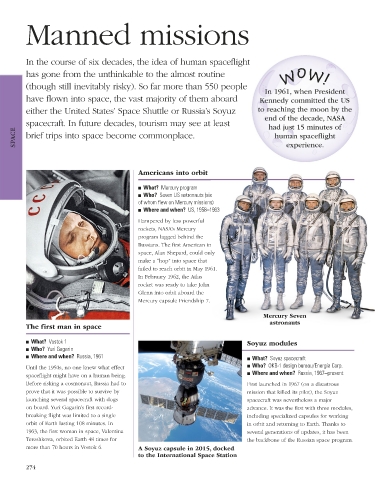
                                              Americans into orbit


                                              ■ ■ What?  Mercury program
                                              ■ ■ Who?  Seven US astronauts (six
                                              of whom flew on Mercury missions)
                                              ■ ■ Where and when?  US, 1958–1963
                                              Hampered by less powerful
                                              rockets, NASA’s Mercury
                                              program lagged behind the
                                              Russians. The first American in
                                              space, Alan Shepard, could only
                                              make a “hop” into space that
                                              failed to reach orbit in May 1961.
                                              In February 1962, the Atlas
                                              rocket was ready to take John
                                              Glenn into orbit aboard the
                                              Mercury capsule Friendship 7.

                                                                                       Mercury Seven
                                                                                         astronauts
          The first man in space

          ■ ■ What?  Vostok 1                                                     Soyuz modules
          ■ ■ Who?  Yuri Gagarin
          ■ ■ Where and when?  Russia, 1961                                        ■ What?  Soyuz spacecraft
                                                                                  ■
          Until the 1950s, no one knew what effect                                ■ ■ Who?  OKB-1 design bureau/Energia Corp.
          spaceflight might have on a human being.                                ■ ■ Where and when?  Russia, 1967–present
          Before risking a cosmonaut, Russia had to                               First launched in 1967 (on a disastrous
          prove that it was possible to survive by                                mission that killed its pilot), the Soyuz
          launching several spacecraft with dogs                                  spacecraft was nevertheless a major
          on board. Yuri Gagarin’s first record-                                  advance. It was the first with three modules,
          breaking flight was limited to a single                                 including specialized capsules for working
          orbit of Earth lasting 108 minutes. In                                  in orbit and returning to Earth. Thanks to
          1963, the first woman in space, Valentina                               several generations of updates, it has been
          Tereshkova, orbited Earth 48 times for                                  the backbone of the Russian space program.
          more than 70 hours in Vostok 6.     A Soyuz capsule in 2015, docked
                                              to the International Space Station
          274


   US_274-275_Manned_missions_Gallery.indd   274                                                                 08/03/18   3:10 PM

