


Page 66 - (DK Eyewitness) Travel Guide - Sweden
P. 66
64 ST OCKHOLM AREA B Y AREA
creative minds by means of
short films and original artifacts.
On the upper floor, the Swedish
Academy holds its ceremonial
gatherings, a tradition
maintained since Gustav III
gave his inauguration speech
here in 1786.
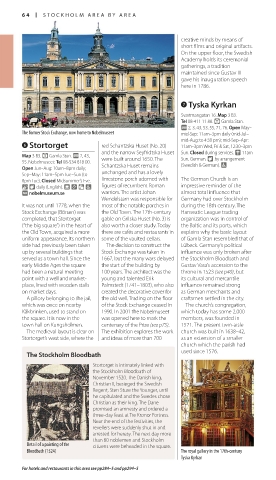
7 Tyska Kyrkan
Svartmangatan 16. Map 3 B3.
Tel 08-411 11 88. Gamla Stan.
@ 2, 3, 43, 53, 55, 71, 76. Open May–
The former Stock Exchange, now home to Nobelmuseet mid-Sep: 11am–3pm daily (mid-Jul–
mid-Aug: to 4:30 pm); mid-Sep–Apr:
6 Stortorget red Schantzska Huset (No. 20) 11am–3pm Wed, Fri & Sat, 12:30–3pm
and the narrow Seyfridtska Huset Sun. Closed during services. 5 11am
Map 3 B3. Gamla Stan. @ 2, 43, were built around 1650. The Sun, German. 8 by arrangement
55. Nobelmuseet: Tel 08-534 818 00. (Swedish & German). 7
Open Jun–Aug: 10am–8pm daily; Schantzska Huset remains
Sep–May: 11am–5pm Tue–Sun (to unchanged and has a lovely
8pm Tue). Closed Midsummer’s Eve. limestone porch adorned with The German Church is an
& 8 daily (English). - 0 = 7 figures of recumbent Roman impressive reminder of the
∑ nobelmuseum.se warriors. The artist Johan almost total influence that
Wendelstam was responsible for Germany had over Stockholm
It was not until 1778, when the most of the notable porches in during the 18th century. The
Stock Exchange (Börsen) was the Old Town. The 17th-century Hanseatic League trading
completed, that Stortorget gable on Grilska Huset (No. 3) is organization was in control of
(“the big square”) in the heart of also worth a closer study. Today the Baltic and its ports, which
the Old Town, acquired a more there are cafés and restaurants in explains why the basic layout
uniform appearance. Its northern some of the vaulted cellars. of Gamla Stan resembled that of
side had previously been taken The decision to construct the Lübeck. Germany’s political
up by several buildings that Stock Exchange was taken in influence was only broken after
served as a town hall. Since the 1667, but the many wars delayed the Stockholm Bloodbath and
early Middle Ages the square the start of the building by Gustav Vasa’s accession to the
had been a natural meeting 100 years. The architect was the throne in 1523 (see p40), but
point with a well and market- young and talented Erik its cultural and mercantile
place, lined with wooden stalls Palmstedt (1741–1803), who also influence remained strong
on market days. created the decorative cover for as German merchants and
A pillory belonging to the jail, the old well. Trading on the floor craftsmen settled in the city.
which was once on nearby of the Stock Exchange ceased in The church’s congregation,
Kåkbrinken, used to stand on 1990. In 2001 the Nobelmuseet which today has some 2,000
the square. It is now in the was opened here to mark the members, was founded in
town hall on Kungsholmen. centenary of the Prize (see p75). 1571. The present twin-aisle
The medieval layout is clear on The exhibition explores the work church was built in 1638–42,
Stortorget’s west side, where the and ideas of more than 700 as an extension of a smaller
church which the parish had
used since 1576.
The Stockholm Bloodbath
Stortorget is intimately linked with
the Stockholm Bloodbath of
November 1520. The Danish king,
Christian II, besieged the Swedish
Regent, Sten Sture the Younger, until
he capitulated and the Swedes chose
Christian as their king. The Dane
promised an amnesty and ordered a
three-day feast at Tre Kronor Fortress.
Near the end of the festivities, the
revellers were suddenly shut in and
arrested for heresy. The next day more
than 80 noblemen and Stockholm
Detail of a painting of the citizens were beheaded in the square.
Bloodbath (1524) The royal gallery in the 17th-century
Tyska Kyrkan
For hotels and restaurants in this area see pp284–5 and pp294–5
064-065_EW_Sweden.indd 64 11/07/16 11:43 am

