


Page 67 - (DK Eyewitness) Travel Guide - Sweden
P. 67
GA MLA ST AN 65
In German Late Renaissance and Town, and is usually
Baroque style, the interior has a thronging with people –
royal gallery, added in 1672 for tourists and locals –
German members of the royal shopping or strolling.
household. The pulpit (1660) in Starting at Mynttorget in
ebony and alabaster is unique the north, by the Chancery
in Sweden and the altar, from the Office (Kanslihuset) and
1640s, is covered with paintings Lejonbacken, the lively
surrounded by sculp tures of the and atmospheric street
apostles and evangelists. finishes at Järntorget in
The sculptures on the south the south, where the
porch by Jobst Hennen date export of iron was once
from 1643 and show Jesus, controlled. On Järntorget
Moses and three figures portray- is Bancohuset, which
ing Faith, Hope and Love. served as the headquarters
of the State Bank from
1680 to 1906.
The building at No. 7
has been used by the
Swedish Parliament since
the mid-1990s. Its late
19th-century façade has Västerlånggatan, Gamla Stan’s most popular
a distinctive southern shopping street
European influence.
No. 27 was built by and for Erik About 100 years later the
Palmstedt, who also designed majestic-looking Post Office
the Stock Exchange and the well was built, incorporating parts
at Stortorget. No. 29 is a truly of the 17th-century buildings.
venerable building, dating from Stockholm’s only Post Office
the early 15th century. The until 1869, it was turned into a
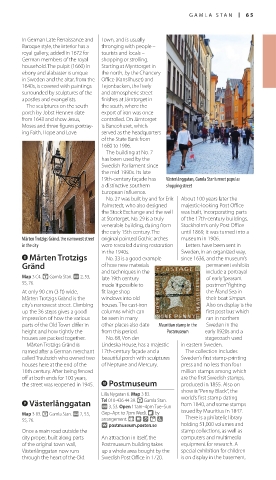
Mårten Trotzigs Gränd, the narrowest street original pointed Gothic arches museum in 1906.
in the city were revealed during restoration Letters have been sent in
in the 1940s. Sweden, in an organized way,
8 Mårten Trotzigs No. 33 is a good example since 1636, and the museum’s
Gränd of how new materials permanent exhibits
and techniques in the include a portrayal
Map 3 C4. Gamla Stan. @ 2, 53, late 19th century of early “peasant
55, 76. made it possible to postmen” fighting
At only 90 cm (3 ft) wide, fit large shop the Åland Sea in
Mårten Trotzigs Gränd is the windows into old their boat Simpan.
city’s narrowest street. Climbing houses. The cast-iron Also on display is the
up the 36 steps gives a good columns which can first post bus which
impression of how the various be seen in many ran in northern
parts of the Old Town differ in other places also date Mauritian stamp in the Sweden in the
height and how tightly the from this period. Postmuseum early 1920s and a
houses are packed together. No. 68, Von der stagecoach used
Mårten Trotzigs Gränd is Lindeska House, has a majestic in eastern Sweden.
named after a German merchant 17th-century façade and a The collection includes
called Traubzich who owned two beautiful porch with sculptures Sweden’s first stamp-printing
houses here at the end of the of Neptune and Mercury. press and no less than four
16th century. After being fenced million stamps among which
off at both ends for 100 years, are the first Swedish stamps,
the street was reopened in 1945. 0 Postmuseum produced in 1855. Also on
show is “Penny Black”, the
Lilla Nygatan 6. Map 3 B3. world’s first stamp dating
9 Västerlånggatan Tel 010-436 44 39. Gamla Stan. from 1840, and some stamps
@ 3, 53. Open 11am–4pm Tue–Sun
Map 3 B3. Gamla Stan. @ 2, 53, (Sep–Apr: to 7pm Wed). 8 by issued by Mauritius in 1847.
There is a philatelic library
55, 76. arrangement. 9 - 0 = 7
∑ postmuseum.posten.se holding 51,000 volumes and
Once a main road outside the stamp collections, as well as
city proper, built along parts An attraction in itself, the computers and multimedia
of the original town wall, Postmuseum building takes equipment for research. A
Västerlånggatan now runs up a whole area bought by the special exhibition for children
through the heart of the Old Swedish Post Office in 1720. is on display in the basement.
064-065_EW_Sweden.indd 65 11/07/16 11:43 am

