


Page 106 - (DK Eyewitness) Travel Guide - Hungary
P. 106
104 BUD APEST AREA B Y AREA CENTR AL PEST 105
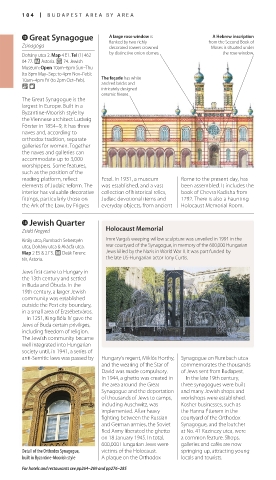
e Great Synagogue A large rose window is A Hebrew inscription u New Theatre
Zsinagóga flanked by two richly from the Second Book of Új Színház
Moses is situated under
decorated towers crowned
Dohány utca 2. Map 4 E1. Tel (1) 462 by distinctive onion domes. the rose window. Paulay Ede utca 35. Map 2 E5.
04 77. q Astoria. v 74. Jewish Tel (1) 269 60 21. q Opera.
Museum: Open 10am–6pm Sun–Thu
(to 8pm May–Sep; to 4pm Nov–Feb); Originally completed in 1909,
10am–4pm Fri (to 2pm Oct–Feb). The façade has white this building has undergone
& 8 and red bricks and many transformations. It was
intricately designed
ceramic friezes. designed by Béla Lajta in
The Great Synagogue is the the Secession style, and,
largest in Europe. Built in a as the home of the cabaret
Byzantine-Moorish style by troupe Parisian Mulató,
the Viennese architect Ludwig became a shrine to frivolity.
Förster in 1854–9, it has three In 1921 the building was
naves and, according to completely restyled by
orthodox tradition, separate László Vágó, who turned it
galleries for women. Together into a theatre. After World
the naves and galleries can War II, the theatre gained a
accommodate up to 3,000 glass-and-steel façade, and
worshippers. Some features, a children’s theatre company
such as the position of the was based here.
reading platform, reflect Feszl. In 1931, a museum Rome to the present day, has Between 1988 and 1990 the
elements of Judaic reform. The was estab lished, and a vast been assembled. It includes the building was returned to its
interior has valuable decorative collection of historical relics, book of Chevra Kadisha from original form, using Lajta’s plans.
fittings, particularly those on Judaic devotional items and 1792. There is also a haunting Gilding, stained glass and marble
the Ark of the Law, by Frigyes everyday objects, from ancient Holo caust Memorial Room. once more adorn this unusual
building. Today, Hungary’s New
r Jewish Quarter Theatre is in residence here.
Zsidó Negyed Holocaust Memorial i House of Terror
Király utca, Rumbach Sebestyén Imre Varga’s weeping willow sculpture was unveiled in 1991 in the Museum
utca, Dohány utca & Akácfa utca. rear courtyard of the Synagogue, in memory of the 600,000 Hungarian
Map 2 E5 & 2 F5. q Deák Ferenc Jews killed by the Nazis in World War II. It was part funded by Terror Háza Múzeum
tér, Astoria. the late US-Hungarian actor Tony Curtis. The Liszt Academy’s Grand Hall, with gilding restored to its 1907 magnificence Andrássy út 60. Map 2 F4. Tel (1) 374
26 00. q Vörösmarty utca. v 4, 6 to
Jews first came to Hungary in t New York Palace y Liszt Academy Oktogon. Open 10am–6pm Tue–Sun.
the 13th century and settled of Music & ∑ terrorhaza.hu
in Buda and Óbuda. In the New York palota
19th century, a larger Jewish Erzsébet körút 9–11. Map 2 F5. Liszt Ferenc Zeneakadémia The museum records in graphic
community was established Tel (1) 886 61 11. q Blaha Lujza tér. Liszt Ferenc tér 8. Map 2 F4. detail the grim events that took
outside the Pest city boundary, v 4, 6.∑ budapest.boscolo Tel (1) 321 06 90. v 4, 6 to Király place here from 1936 – when
in a small area of Erzsébetváros. hotels.com utca. 8 by prior arrangement. the Arrow Cross (the Hungarian
In 1251, King Béla IV gave the ∑ lisztacademy.hu Nazi Party) took over the
Jews of Buda certain priviliges, Built in 1891–5 to a design by building as its headquarters –
including freedom of religion. the architect Alajos Hausz mann, The Academy is housed in a until 1956, when it was
The Jewish community became the New York Palace was once the late Historicist palace, built in turned into a club for Young
well integrated into Hungarian offices of an American insur ance 1904–7 by Kálmán Giergl and Communists. Set over three
society until, in 1941, a series of firm. Today it is a luxurious 5-star Flóris Korb. Above the main floors, the most chilling part of
anti-Semitic laws was passed by Hungary’s regent, Miklós Horthy, Synagogue on Rumbach utca hotel. The building displays an entrance there is a statue of the museum is the basement,
and the wearing of the Star of commemorates the thousands eclectic mix of Neo-Baroque and Ferenc (Franz) Liszt, by Alajos where the various types of
David was made compulsory. of Jews sent from Budapest. Secession motifs. The decorative Stróbl. The six bas-reliefs above prison cell have been recreated.
In 1944, a ghetto was created in In the late 19th century, sculptures that animate the façade its base are by Ede Telcs, and
the area around the Great three synagogues were built are the work of Károly Senyei. depict the history of music.
Synagogue and the deportation and many Jewish shops and On the ground floor is the Restoration has recreated
of thousands of Jews to camps, workshops were established. renowned New York Café. Its the Secessionist interior in
including Auschwitz, was Kosher businesses, such as walls are adorned with paintings all its original splendour,
implemented. After heavy the Hanna Étterem in the by Gusztáv Mann heimer and while also outfitting the
fighting between the Russian courtyard of the Orthodox Károly Lotz. The beautiful, richly per formance spaces with
and German armies, the Soviet Synagogue, and the butcher gilded Neo-Baroque interior, 21st-century technology.
Red Army liberated the ghetto at No. 41 Kazinczy utca, were with its grand chandeliers and The jewel is the ornate
on 18 January 1945. In total, a common feature. Shops, marble pillars, was once the Grand Hall, a world-famous
600,000 Hungarian Jews were galleries and cafés are now favourite haunt of literary and concert venue – not only
Detail of the Orthodox Synagogue, victims of the Holocaust. springing up, attracting young artistic circles, though today it for its beauty, but also because The House of Terror Museum, docu menting
built in Byzantine-Moorish style A plaque on the Orthodox locals and tourists. tends to attract mainly tourists. of its superb acoustics. tragic 20th-century events
For hotels and restaurants see pp264–269 and pp276–285
104-105_EW_Hungary.indd 104 18/09/17 3:39 pm 104-105_EW_Hungary.indd 105 18/09/17 3:39 pm

