


Page 173 - (DK Eyewitness) Travel Guide - Hungary
P. 173
NOR THERN TR ANSD ANUBIA 171
valuable Lajta rock was hewn
here from the time of the
Antonines, though quarrying
ended shortly after World War II.
What remains is a surreal series
of man-made, uneven caverns,
colonnades and porticoes. In July
the superb acoustics of the main
cavern are put to perfect use as
the setting for musical, dance and
opera performances as part of
the Sopron Festival Week.
A nature trail across the
grasslands above the quarry
offers magnificent, panoramic
views of Lake Fertő and is also
the site of the Pan-European
Monument, a stark metal sculp-
ture representing part of the
Iron Curtain that commemorates
the opening of the border in 1989.
a Fertőd
25 km (16 miles) east of Sopron.
Road Map A3. * 3,400. £ from
Szombathely. @ from Sopron.
n Tourinform, Joseph Haydn utca 2,
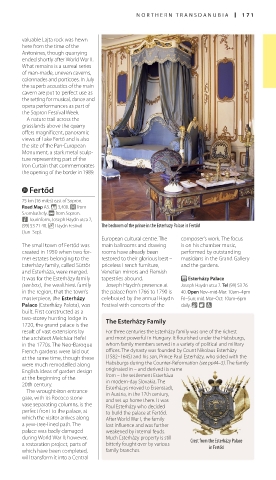
(99) 53 71 40. _ Haydn Festival The bedroom of the prince in the Esterhazy Palace in Fertőd
(Jun–Sep).
European cultural centre. The composer’s work. The focus
The small town of Fertőd was main ballrooms and drawing is on his chamber music,
created in 1950 when two for- rooms have already been performed by outstanding
mer estates belonging to the restored to their glorious best – musicians in the Grand Gallery
Esterházy family, called Süttör priceless French furniture, and the gardens.
and Esterháza, were merged. Venetian mirrors and Flemish
It was for the Esterházy family tapestries abound. P Esterházy Palace
(see box), the wealthiest family Joseph Haydn’s presence at Joseph Haydn utca 2. Tel (99) 53 76
in the region, that the town’s the palace from 1766 to 1790 is 40. Open Nov–mid-Mar: 10am–4pm
masterpiece, the Esterházy celebrated by the annual Haydn Fri–Sun; mid-Mar–Oct: 10am–6pm
Palace (Esterházy Palota), was Festival with concerts of the daily. & 8 7
built. First constructed as a
two-storey hunting lodge in The Esterházy Family
1720, the grand palace is the
result of vast extensions by For three centuries the Esterházy family was one of the richest
the architect Melchior Hefel and most powerful in Hungary. It flourished under the Habsburgs,
in the 1770s. The Neo-Baroque whom family members served in a variety of political and military
French gardens were laid out offices. The dynasty was founded by Count Nikolaus Esterházy
at the same time, though these (1582–1645) and his son, Prince Paul Esterházy, who sided with the
were much remodelled along Habsburgs during the Counter-Reformation (see pp44–5). The family
English ideas of garden design originated in – and derived its name
at the beginning of the from – the settlement Esterháza
in modern-day Slovakia. The
20th century. Esterházys moved to Eisenstadt,
The wrought-iron entrance in Austria, in the 17th century,
gate, with its Rococo stone and set up home there. It was
vase separating columns, is the Paul Esterházy who decided
perfect front to the palace, at to build the palace at Fertőd.
which the visitor arrives along After World War I, the family
a yew-tree-lined path. The lost influence and was further
palace was badly damaged weakened by internal feuds.
during World War II; however, Much Esterházy property is still Crest from the Esterházy Palace
a restoration project, parts of bitterly fought over by various in Fertőd
which have been completed, family branches.
will transform it into a Central
170-171_EW_Hungary.indd 171 18/09/17 3:40 pm

