


Page 31 - (DK Eyewitness) Travel Guide - Hungary
P. 31
A POR TR AIT OF HUNGAR Y 29
Renaissance and Baroque (1450–1800)
Renaissance architecture was a successful attempt to incorporate the grandeur of Rome into
the contemporary world. Led by the Italians Brunelleschi and Bramante, the concept of art for art’s
sake became paramount, with buildings being designed around their
façades. In Hungary the movement found royal favour from King Mátyás,
who was greatly influenced by his Italian wife, Beatrice. The Hungarian
Renaissance was brought to an end by the Turks, who destroyed many
of its greatest achievements.
After they were expelled from
Hungary in 1690, the Baroque
era began, characterized by
grand designs which reflected
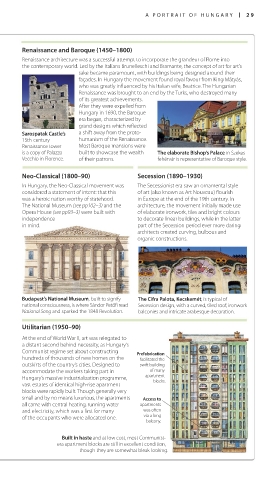
Sarospatak Castle’s a shift away from the proto-
15th-century humanism of the Renaissance.
Renaissance tower Most Baroque mansions were
is a copy of Palazzo built to showcase the wealth The elaborate Bishop’s Palace in Szekes-
Vecchio in Florence. of their patrons. fehérvár is representative of Baroque style.
Neo-Classical (1800–90) Secession (1890–1930)
In Hungary, the Neo-Classical movement was The Secessionist era saw an ornamental style
considered a statement of intent: that this of art (also known as Art Nouveau) flourish
was a heroic nation worthy of statehood. in Europe at the end of the 19th century. In
The National Museum (see pp102–3) and the architecture, the movement initially made use
Opera House (see pp93–3) were built with of elaborate ironwork, tiles and bright colours
independence to decorate linear buildings, while in the latter
in mind. part of the Secession period ever more daring
architects created curving, bulbous and
organic constructions.
Budapest’s National Museum, built to signify The Cifra Palota, Kecskemét, is typical of
national consciousness, is where Sándor Petőfi read Secession design, with a curved, tiled roof, ironwork
National Song and sparked the 1848 Revolution. balconies and intricate arabesque decoration.
Utilitarian (1950–90)
At the end of World War II, art was relegated to
a distant second behind necessity, as Hungary’s
Communist regime set about constructing Prefabrication
hundreds of thousands of new homes on the facilitated the
outskirts of the country’s cities. Designed to swift building
accommodate the workers taking part in of many
Hungary’s massive industrialization programme, apartment
blocks.
vast estates of identical high-rise apartment
blocks were rapidly built. Though generally very
small and by no means luxurious, the apartments Access to
all came with central heating, running water apartments
and electricity, which was a first for many was often
of the occupants who were allocated one. via a long
balcony.
Built in haste and at low cost, most Communist-
era apartment blocks are still in excellent condition,
though they are somewhat bleak-looking.
Hun_028-029_FEAT.indd 29 17/02/2015 13:00

