


Page 28 - (DK Eyewitness) Travel Guide - Hungary
P. 28
26 INTRODUCING HUNGAR Y A POR TR AIT OF HUNGAR Y 27
Thermal Springs and Baths Best Thermal Baths Outdoor Pools
are open all year
round, even in the
Hungary has been one of Europe’s great spa destinations • Aquaticum see p255 depths of winter.
for hundreds of years. Natural hot springs pour out over • Bükfürdő see p167 Taking a bath in the
• Gellért Hotel and Baths
80 million litres (18 million gallons) of richly mineralized Complex see pp74–5 steaming water when
water every day. There are more than 1,300 hot springs • Hajdúszoboszló the air temperature is
in the country, of which 300 are used for bathing and Medicinal Spa see p256 below zero is a unique
experience. In summer,
medicinal purposes. A third of these are in Budapest, which • Lake Hévíz see p204 the outdoor pools can
• Miskolctapolca see p229
has the greatest concentration of natural springs. Baths • Nagyatád see p194 get very busy.
have existed since Roman times but it was the Turks who • Parádfürdő see p217
exploited the natural waters for healing all sorts of ailments. • Sárvár Spa see p167
• Széchenyi Baths see p111
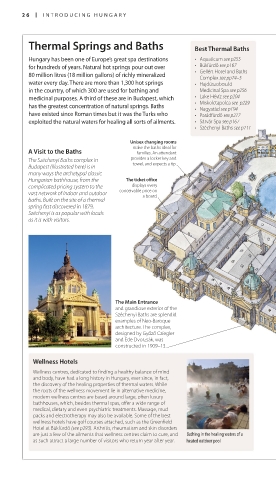
Unisex changing rooms
make the baths ideal for
A Visit to the Baths families. An attendant The terrace at the rear
The Széchenyi Baths complex in provides a locker key and of Széchenyi Baths
towel, and expects a tip.
serves refreshing cold
Budapest (illustrated here) is in drinks to bathers.
many ways the archetypal classic
Hungarian bathhouse, from the The ticket office
displays every
complicated pricing system to the conceivable price on
vast network of indoor and outdoor a board.
baths. Built on the site of a thermal
spring first discovered in 1879,
Széchenyi is as popular with locals Chess being played is a
as it is with visitors. common sight at baths in
Hungary. Matches take place
at outdoor pools all year
round, even when there is
snow on the ground.
Saunas and steam rooms
are used by bathers after taking
a hot bath, before bathing
again in cooler water.
The Main Entrance
and grandiose exterior of the
Széchenyi Baths are splendid
examples of Neo-Baroque
architecture. The complex,
designed by Győző Cziegler
and Ede Dvorzsák, was
constructed in 1909–13.
Wellness Hotels
Wellness centres, dedicated to finding a healthy balance of mind
and body, have had a long history in Hungary, ever since, in fact,
the discovery of the healing properties of thermal waters. While
the roots of the wellness movement lie in alternative medicine,
modern wellness centres are based around large, often luxury
bathhouses, which, besides thermal spas, offer a wide range of The spacious and At pools used for
medical, dietary and even psychiatric treatments. Massage, mud elegant interior medicinal purposes
packs and electrotherapy may also be available. Some of the best of the Széchenyi water temperatures are
wellness hotels have golf courses attached, such as the Greenfield entrance hall, like that of clearly displayed at the edge
Hotel at Bükfürdő (see p293). Arthritis, rheumatism and skin disorders many baths in Hungary, of the pool. The hotter the
are just a few of the ailments that wellness centres claim to cure, and Bathing in the healing waters of a is in stark contrast to the water, it is said, the stronger
as such attract a large number of visitors who return year after year. heated outdoor pool changing rooms, which its healing powers.
can be a little cramped.
Hun_026-027_FEAT.indd 26 17/02/2015 13:00 Hun_026-027_FEAT.indd 27 17/02/2015 13:00

