


Page 30 - (DK Eyewitness) Travel Guide - Hungary
P. 30
28 INTRODUCING HUNGAR Y A POR TR AIT OF HUNGAR Y 29
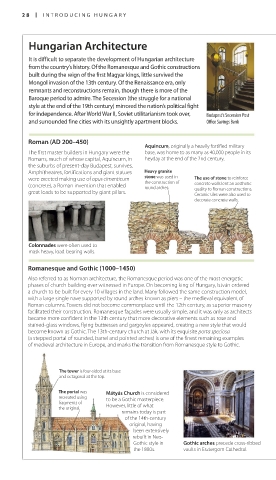
Hungarian Architecture Renaissance and Baroque (1450–1800)
It is difficult to separate the development of Hungarian architecture Renaissance architecture was a successful attempt to incorporate the grandeur of Rome into
from the country’s history. Of the Romanesque and Gothic constructions the contemporary world. Led by the Italians Brunelleschi and Bramante, the concept of art for art’s
built during the reign of the first Magyar kings, little survived the sake became paramount, with buildings being designed around their
Mongol invasion of the 13th century. Of the Renaissance era, only façades. In Hungary the movement found royal favour from King Mátyás,
who was greatly influenced by his Italian wife, Beatrice. The Hungarian
remnants and reconstructions remain, though there is more of the Renaissance was brought to an end by the Turks, who destroyed many
Baroque period to admire. The Secession (the struggle for a national of its greatest achievements.
style at the end of the 19th century) mirrored the nation’s political fight After they were expelled from
for independence. After World War II, Soviet utilitarianism took over, Budapest’s Secession Post Hungary in 1690, the Baroque
and surrounded fine cities with its unsightly apartment blocks. Office Savings Bank era began, characterized by
grand designs which reflected
Sarospatak Castle’s a shift away from the proto-
Roman (AD 200–450) 15th-century humanism of the Renaissance.
Aquincum, originally a heavily fortified military Renaissance tower Most Baroque mansions were
The first master builders in Hungary were the base, was home to as many as 40,000 people in its is a copy of Palazzo built to showcase the wealth The elaborate Bishop’s Palace in Szekes-
Romans, much of whose capital, Aquincum, in heyday at the end of the 2nd century. Vecchio in Florence. of their patrons. fehérvár is representative of Baroque style.
the suburbs of present-day Budapest, survives.
Amphitheatres, fortifications and giant statues Heavy granite
were erected making use of opus cimenticum stone was used in The use of stone to reinforce Neo-Classical (1800–90) Secession (1890–1930)
the construction of
(concrete), a Roman invention that enabled round arches. concrete walls lent an aesthetic In Hungary, the Neo-Classical movement was The Secessionist era saw an ornamental style
quality to Roman constructions.
great loads to be supported by giant pillars. Ceramic tiles were also used to considered a statement of intent: that this of art (also known as Art Nouveau) flourish
decorate concrete walls. was a heroic nation worthy of statehood. in Europe at the end of the 19th century. In
The National Museum (see pp102–3) and the architecture, the movement initially made use
Opera House (see pp93–3) were built with of elaborate ironwork, tiles and bright colours
independence to decorate linear buildings, while in the latter
in mind. part of the Secession period ever more daring
architects created curving, bulbous and
organic constructions.
Colonnades were often used to
mask heavy, load-bearing walls.
Romanesque and Gothic (1000–1450)
Also referred to as Norman architecture, the Romanesque period was one of the most energetic
phases of church building ever witnessed in Europe. On becoming king of Hungary, István ordered
a church to be built for every 10 villages in the land. Many followed the same construction model,
with a large single nave supported by round arches known as piers – the medieval equivalent of Budapest’s National Museum, built to signify The Cifra Palota, Kecskemét, is typical of
Roman columns. Towers did not become commonplace until the 12th century, as superior masonry national consciousness, is where Sándor Petőfi read Secession design, with a curved, tiled roof, ironwork
facilitated their construction. Romanesque façades were usually simple, and it was only as architects National Song and sparked the 1848 Revolution. balconies and intricate arabesque decoration.
became more confident in the 13th century that more decorative elements such as rose and
stained-glass windows, flying buttresses and gargoyles appeared, creating a new style that would Utilitarian (1950–90)
become known as Gothic. The 13th-century church at Ják, with its exquisite porta speciosa
(a stepped portal of rounded, barrel and pointed arches) is one of the finest remaining examples At the end of World War II, art was relegated to
of medieval architecture in Europe, and marks the transition from Romanesque style to Gothic. a distant second behind necessity, as Hungary’s
Communist regime set about constructing Prefabrication
hundreds of thousands of new homes on the facilitated the
outskirts of the country’s cities. Designed to swift building
The tower is four-sided at its base accommodate the workers taking part in of many
and octagonal at the top. Hungary’s massive industrialization programme, apartment
vast estates of identical high-rise apartment blocks.
The portal was Mátyás Church is considered blocks were rapidly built. Though generally very
recreated using to be a Gothic masterpiece. small and by no means luxurious, the apartments Access to
fragments of all came with central heating, running water apartments
the original. However, little of what was often
remains today is part and electricity, which was a first for many via a long
of the 14th-century of the occupants who were allocated one. balcony.
original, having
been extensively
rebuilt in Neo- Built in haste and at low cost, most Communist-
Gothic style in Gothic arches precede cross-ribbed era apartment blocks are still in excellent condition,
the 1880s. vaults in Esztergom Cathedral. though they are somewhat bleak-looking.
Hun_028-029_FEAT.indd 28 17/02/2015 13:00 Hun_028-029_FEAT.indd 29 17/02/2015 13:00

