


Page 33 - (DK Eyewitness) Travel Guide - Hungary
P. 33
A POR TR AIT OF HUNGAR Y 31
Hungary, so far, has bagged
four Oscars: The Fly (1980), a
short animation film by Ferenc
Rúfusz; Mephisto (1981), by
István Szabó, and András
Nemes-Jeles’ Son of Saul (2016)
both won Best Foreign
Language Film; and Kristóf
Deák’s 2017 short film, Sing.
Hungarian visual artists have
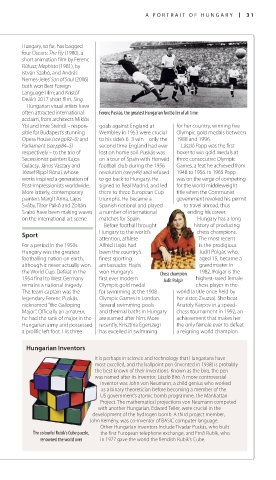
often attracted international Ferenc Puskás, the greatest Hungarian footballer of all time
acclaim, from architects Miklós
Ybl and Imre Steindl – respon- goals against England at for her country, winning five
sible for Budapest’s stunning Wembley in 1953 were crucial Olympic gold medals between
Opera House (see pp92–3) and to his side’s 6–3 win – only the 1988 and 1996.
Parliament (see pp84–5) second time England had ever László Papp was the first
respectively – to the trio of lost on home soil. Puskás was boxer to win gold medals at
Secessionist painters Lajos on a tour of Spain with Honvéd three consecutive Olympic
Gulácsy, János Vaszary and football club during the 1956 Games, a feat he achieved from
József Rippl-Rónai, whose revolution (see p49) and refused 1948 to 1956. In 1965 Papp
works inspired a generation of to go back to Hungary. He was on the verge of competing
Post-Impressionists worldwide. signed to Real Madrid, and led for the world middleweight
More latterly, contemporary them to three European Cup title when the Communist
painters Margit Anna, Lajos triumphs. He became a government revoked his permit
Sváby, Tibor Palkó and Zoltán Spanish national and played to travel abroad, thus
Szabó have been making waves a number of international ending his career.
on the international art scene. matches for Spain. Hungary has a long
Before football brought history of producing
Sport Hungary to the world’s chess champions.
attention, athlete The most recent
For a period in the 1950s Alfréd Hajós had is the prodigious
Hungary was the greatest been the country’s Judit Polgár, who,
footballing nation on earth, finest sporting aged 15, became a
although it never actually won ambassador. Hajós grandmaster in
the World Cup. Defeat in the won Hungary’s Chess champion 1982. Polgár is the
1954 final to West Germany first ever modern Judit Polgár highest-rated female
remains a national tragedy. Olympic gold medal chess player in the
The team captain was the for swimming at the 1908 world (a title once held by
legendary Ferenc Puskás, Olympic Games in London. her sister, Zsuzsa). She beat
nicknamed “the Galloping Several swimming pools Anatoly Karpov in a speed-
Major”. Officially an amateur, and thermal baths in Hungary chess tournament in 1992, an
he had the rank of major in the are named after him. More achievement that makes her
Hungarian army and possessed recently, Krisztina Egerszegi the only female ever to defeat
a prolific left foot. His three has excelled in swimming a reigning world champion.
Hungarian Inventors
It is perhaps in science and technology that Hungarians have
most excelled, and the ballpoint pen (invented in 1938) is probably
the best known of their inventions. Known as the biro, the pen
was named after its inventor, László Bíró. A more controversial
inventor was John von Neumann, a child genius who worked
as a binary theoretician before becoming a member of the
US government’s atomic bomb programme, the Manhattan
Project. The mathematical projections von Neumann computed
with another Hungarian, Edward Teller, were crucial in the
development of the hydrogen bomb. A third project member,
John Kemény, was co-inventor of BASIC computer language.
Other Hungarian inventors include Tivadar Puskás, who built
The colourful Rubik’s Cube puzzle, the first European telephone exchange, and Ernő Rubik, who
renowned the world over in 1977 gave the world the fiendish Rubik’s Cube.
030-031_EW_Hungary.indd 31 18/09/17 3:39 pm

