


Page 41 - (DK Eyewitness) Travel Guide - Hungary
P. 41
INTRODUCING HUNGAR Y 39
THE HISTORY OF
HUNGARY
Most modern histories give little space to pre-Magyar Hungary but, given
the importance of the region both then and now, this is a shame. Hungary’s
geographical location, at the heart of the European continent, has made it
pivotal in invasions and empire-building from a time long before the notion
of Europe – or Hungary – had ever been contemplated.
There is evidence that the Great Plain Urals, rolled into the region in 895 or 896.
has been inhabited since the Bronze Age. It was at this time that Hungarian history
Horsemen from the steppes eventually first became entangled in conflict. The
destroyed the existing culture in the Magyars claim to have arrived in a desolate,
13th century BC. Celts later occupied parts sparsely populated land (the Slavs having
of the land, and in AD 10 to 35, in its final moved south into the Balkans at the end
push for expansion, Rome conquered of the 8th century); meanwhile, Romanian
Transdanubia, renaming it Pannonia, historians – to support their claim on
and later adding Dacia. Transylvania – insist that the Carpathian
The Romans developed an urban basin was in fact inhabited by direct
infrastructure, including paved roads, city descendants of the Romans.
forums, stadiums and baths, in Northern The Magyars first settled on Csepel
Transdanubia, still visible today in the Island, in the middle of the Danube
ruined remains of Aquin cum, Óbuda, just south of present-day Budapest,
Szombathely and Sopron. before quickly occupying much of the
Barbarian tribes finally put an end to the surrounding area. Tradition holds that
rule of Rome. In 271 Dacia was abandoned once the entire Carpathian basin had
as too expensive and troublesome to been occupied – and what little resistance
defend; Pannonia was similarly left to its there was had been quelled – the Magyar
fate in 403. Gothic, Hun, Avar and Slav clan leaders chose a chieftain named
tribes by turns filled the void; indeed, the Árpád to lead them, and that they swore
Hun king Attila ran his powerful but short- an oath by sipping from a cup of their
lived empire from here. mixed blood to accept Árpád’s male
descendants as the Magyars’ hereditary
The Magyars chieftains. Estimates suggest that Árpád
The Magyars, a nomadic, pagan, Finno- ruled over some 400,000 people, made
Ugric tribe whose ancient homeland is up of seven Magyar, one Kabar, and other
thought to have been an area east of the smaller tribes.
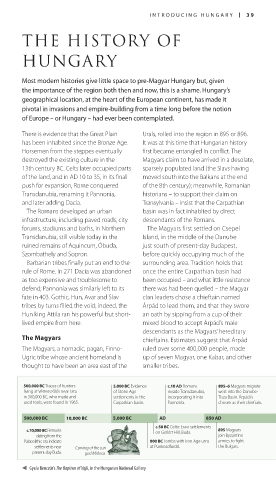
500,000 BC Traces of hunters 5,000 BC Evidence c.10 AD Romans 895–6 Magyars migrate
living at Vértesszőlős near Tata of Stone Age invade Transdanubia, west into the Danube-
in 500,000 BC, who made and settlements in the incorporating it into Tisza Basin. Árpád is
used tools, were found in 1965. Carpathian basin. Pannonia. chosen as their chieftain.
500,000 BC 10,000 BC 5,000 BC AD 850 AD
c.50 BC Celtic Eravi settle ments
c.10,000 BC Remains on Gellért Hill, Buda. 895 Magyars
dating from the join Byzantine
Palaeolithic era indicate 800 BC Tombs with Iron Age urns armies to fight
settlements near Carving of the sun at Pünkösdfürdő. the Bulgars.
present-day Buda. god Mithras
Gyula Benczúr’s The Baptism of Vajk, in the Hungarian National Gallery
Hun_038-041_Hist_Opener.indd 39 17/02/2015 12:59

