


Page 46 - (DK Eyewitness) Travel Guide - Hungary
P. 46
44 INTRODUCING HUNGAR Y THE HIST OR Y OF HUNGAR Y 45
in August 1526, annihilating the Hungarian Turks practised religious Habsburg rule
army and Louis II at the Battle of Mohács (see tolerance, giving Hungarians After the expulsion of the Turks,
p187). Rival factions of nobles then elected living within the empire the Austrians colonized Hun
two kings, János Szapolyai (1526–40), significant autonomy. gary with Germans, which led
supported by Eastern nobles and the Turks, Transylvania became to an antiHabsburg revolt in
and Habsburg king Ferdinand (1526–64), an Ottoman vassal state. 1703–11. It was put down and
supported by Western nobles and the Holy It functioned as an the leader, Tran sylv anian prince
Roman Empire. Hungary’s independent country, ruled Ferenc Rákóczi, was forced
partition became final by local princes who paid a into exile, yet the Habs burgs
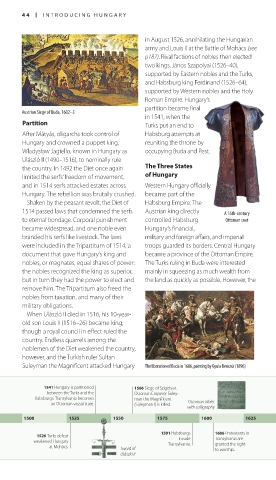
Austrian Siege of Buda, 1602–3
in 1541, when the tribute to the Turks. But the guaranteed constitutional
Partition Turks put an end to princes’ increasing auto independence for Hungary
After Mátyás, oligarchs took control of Habs burg attempts at nomy angered the Turks, Ottoman Campaign Tent, taken during the and restored noble privileges.
Siege of Vienna, 1683
Hungary and crowned a puppet king, reuniting the throne by who routed their armies in Peace and prosperity followed,
Władysław Jagiello, known in Hungary as occupying Buda and Pest. 1660 and took control of Transylvania. first under Empress Maria Theresa (1740–80)
Ulászló II (1490–1516), to nominally rule and later her son, Joseph II (1780–90).
the country. In 1492 the Diet once again The Three States Reunification Enlightened absolutists, they strengthened
limited the serfs’ freedom of movement, of Hungary Hungary’s aristocracy was increasingly their empire by pursuing a more humane
and in 1514 serfs attacked estates across Western Hungary officially dominated by Protestants and opposition social policy. Maria Theresa had Buda and
Hungary. The rebellion was brutally crushed. became part of the to Catholic Habsburg rule grew. Angered Pest rebuilt, and built most of the Habsburg
Shaken by the peasant revolt, the Diet of Habsburg Empire. The by the persecution of Protestants and Royal Palace (see pp58–9) and a floating yet
1514 passed laws that condemned the serfs Austrian king directly A 16th-century insufficient action against the Turks, permanent bridge across the Danube.
to eternal bondage. Corporal punishment controlled Habsburg Ottoman coat an outright rebellion in 1664 failed to Joseph II was even more radical. He
became widespread, and one noble even Hungary’s financial, overthrow the Habs burgs. Instead, Emperor curbed the power of the Church, disbanding
branded his serfs like livestock. The laws military and foreign affairs, and imperial Leopold I suppressed the Hungarian monastic orders, and introduced tax reforms
were included in the Tripartitum of 1514, a troops guarded its borders. Central Hungary constitution, and ruled Habsburg Hungary that limited the powers of the Hungarian
document that gave Hungary’s king and became a province of the Ottoman Empire. from Vienna. Protes tantism was viciously aristocracy. He also made German the
nobles, or magnates, equal shares of power: The Turks ruling in Buda were interested repressed. Hungarian discontent deepened official language, but he died young, in 1790,
the nobles recognized the king as superior, mainly in squeezing as much wealth from still further, until 1681, when Imre Thököly, and many of his reforms died with him.
but in turn they had the power to elect and the land as quickly as possible. However, the a Tran sylvanian nobleman, led a more
remove him. The Tripartitum also freed the successful rebellion against the Habsburgs,
nobles from taxation, and many of their forcing Leopold to restore Hungary’s
military obligations. constitution. It was during these internal
When Ulászló II died in 1516, his 10-year- conflicts that the Turks attacked Austria, only
old son Louis II (1516–26) became king, to be almost wiped out entirely near Vienna
though a royal council in effect ruled the in 1683. A Western campaign then gradually
country. End less quarrels among the drove the Turks from all of Hungary, and the
noblemen of the Diet weakened the country, Ottoman government finally surrendered
however, and the Turkish ruler Sultan its Hungarian possessions at the Peace of
Suleyman the Magnificent attacked Hungary The liberation of Buda in 1686, painting by Gyula Benczúr (1896) Karlowitz in 1699. The return of the Crown to Buda (1790)
1780 Joseph II
1541 Hungary is partitioned 1566 Siege of Szigetvar. 1664 Habsburgs 1683 Turks attack Habsburgs but (1780–90)
between the Turks and the Ottoman Emperor Suley- rout a Turkish are routed near Vienna. succeeds his
Habsburgs. Transylvania becomes man the Magnificent army at St Gott 1686 Christian troops enter Buda. mother, Maria
an Ottoman vassal state. (Suleyman I) is killed. Ottoman tablet hard in Hungary. Order created by Theresa; he enacts
with calligraphy Turkish rule in Hungary ends. Maria Theresa further reform.
1625
1500 1525 1550 1575 1600 1625 1650 1675 1700 1725 1750 1775
1681 Hungarians rebel 1699 Turks lose almost all 1740 Maria Theresa 1792 Coronation of
1591 Habsburgs 1606 Protestants in against Habsburg rule. Hungarian possessions in (1740–80) becomes Ferenc I (1792–1835),
1526 Turks defeat
weakened Hungary invade Transylvania are Peace of Karlowitz, which Habsburg Empress, who repeals many of the
at Mohács. Transylvania. granted the right 1684 Start of ultimately successful formally ends partition. and institutes social reforms carried out by
Sword of to worship. Siege of Buda by Habsburgs. reform. his predecessors.
Ulászló II
044-051_EW_Hungary.indd 44 18/09/17 3:39 pm 044-051_EW_Hungary.indd 45 18/09/17 3:39 pm

